


Page 78 - Journal of Special Operations Medicine - Spring 2014
P. 78
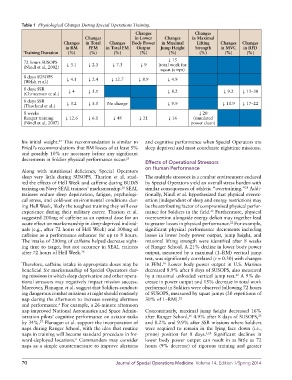
Table 1  Physiological Changes During Special Operations Training.
                                                         Changes                  Changes
                                    Changes              in Lower    Changes    in Maximal
                           Changes   in Total   Changes   Body Power   in Maximal   Lifting    Changes   Changes
                            in BM     FFM    in Total FM   Output    Jump Height    Strength    in MVC    in RFD
           Training Duration  (%)     (%)       (%)        (%)         (%)         (%)        (%)      (%)
                                                                       ↓ 15
           72 hours SUSOPS   ↓ 3.1   ↓ 2.3     ↓ 7.3       ↓ 9     (total work for
           (Nindl et al, 2002)
                                                                   squat jumps)
           8 days SUSOPS     ↓ 4.1   ↓ 2.4     ↓ 12.7     ↓ 8.9       ↓ 4.9
           (Welsh et al.)
           8 days SSR        ↓ 4     ↓ 5.1                            ↓ 8.2                  ↓ 9.2   ↓ 15–30
           (Christensen et al.)
           8 days SSR        ↓ 3.2   ↓ 5.0   No change                ↓ 9.9                  ↓ 10.9  ↓ 17–22
           (Thorlund et al.)
           8 weeks                                                                 ↓ 20
           Ranger training   ↓ 12.6  ↓ 6.1      ↓ 48       ↓ 21        ↓ 16      (simulated
           (Nindl et al, 2007)                                                  power clean)


          his initial weight.  This recommendation is similar to   and cognitive performance when Special Operators are
                         24
          Friedl’s recommendations that BM losses of at least 5%   sleep deprived and must coordinate nighttime missions.
          and possibly 10% are necessary before any significant
          decrements in Soldier physical performance occur. 25
                                                             Effects of Operational Stressors
          Along with nutritional deficiency, Special Operators   on Human Performance
          sleep very little during SUSOPS. Tharion et al. stud-  The multiple stressors in a combat environment endured
          ied the effects of Hell Week and caffeine during BUD/S   by Special Operators yield an overall stress burden with
          training on Navy SEAL trainees’ marksmanship.  SEAL   similar consequences of athletic “overtraining.”  Addi-
                                                                                                      28
                                                   26
          trainees endure sleep deprivation, fatigue, psychologi-  tionally, Nindl et al. hypothesized that physical overex-
          cal stress, and cold-wet environmental conditions dur-  ertion (independent of sleep and energy restriction) may
          ing Hell Week, likely the toughest training they will ever   be the attributing factor of compromised physical perfor-
          experience during their military career. Tharion et al.   mance for Soldiers in the field.  Furthermore, physical
                                                                                        22
          suggested 200mg of caffeine as an optimal dose for an   overexertion alongside energy deficit may together lead
          acute effect on marksmanship in sleep-deprived individ-  to greater losses in physical performance.  For example,
                                                                                                22
          uals (e.g., after 72 hours of Hell Week) and 300mg of   significant  physical performance  decrements  including
          caffeine as a performance enhancer for up to 8 hours.   losses in lower body power output, jump height, and
          The intake of 200mg of caffeine helped decrease sight-  maximal lifting strength were identified after 8 weeks
          ing time to target, but not accuracy in SEAL trainees   of Ranger School. A 21% decline in lower body power
          after 72 hours of Hell Week. 26                    output, measured by a maximal (1–RM) vertical jump
                                                             test, was significantly correlated (r = 0.30) with changes
          Therefore, caffeine intake in appropriate doses may be   in FFM.  Lower body power output in U.S. Marines
                                                                    16
          beneficial for marksmanship of Special Operators dur-  decreased 8.9% after 8 days of SUSOPS, also measured
          ing missions in which sleep deprivation and other opera-  by a maximal unloaded vertical jump test.  A 9% de-
                                                                                                  23
          tional stressors may negatively impact mission success.   crease in power output and 15% decrease in total work
          Moreover, Flanagan et al. suggest that Soldiers conduct-  performed in Soldiers were observed following 72 hours
          ing dangerous combat missions at night should routinely   of SUSOPS, measured by squat jumps (30 repetitions of
          nap during the afternoon to increase evening alertness   30% of 1–RM). 22
          and performance.  For example, a 26-minute afternoon
                         6
          nap improved National Aeronautics and Space Admin-  Concomitantly, maximal jump height decreased 16%
          istration pilots’ cognitive performance on aviator tasks   after Ranger School,  4.9% after 8 days of SUSOPS,
                                                                               16
                                                                                                            23
          by 34%.  Flanagan et al. support the incorporation of   and 8.2% and 9.9% after SSR missions where Soldiers
                  27
          naps during Ranger School, with the idea that routine   were required to remain in the lying face down (i.e.,
          naps in training will become standard procedure in for-  prone) position for 8 days. 5,29  Significant declines in
          ward-deployed  locations.   Commanders  may  consider   lower body power output can result in as little as 72
                                6
          naps as a simple countermeasure to improve alertness   hours (9% decrease) of rigorous training and greater

          70                                     Journal of Special Operations Medicine  Volume 14, Edition 1/Spring 2014

