


Page 97 - ATP-P 11th Ed
P. 97
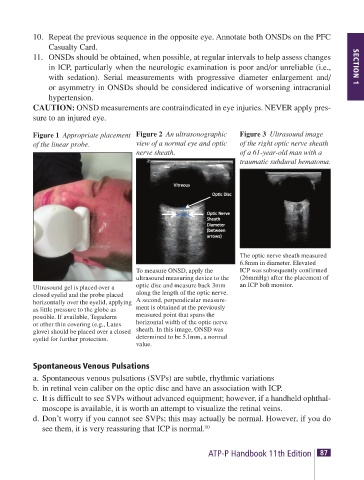
10.  Repeat the previous sequence in the opposite eye. Annotate both ONSDs on the PFC
            Casualty Card.
        11.  ONSDs should be obtained, when possible, at regular intervals to help assess changes
            in ICP, particularly when the neurologic examination is poor and/or unreliable (i.e.,   SECTION 1
            with sedation). Serial measurements with progressive diameter enlargement and/
            or asymmetry in ONSDs should be considered indicative of worsening intracranial
            hypertension.
        CAUTION: ONSD measurements are contraindicated in eye injuries. NEVER apply pres-
        sure to an injured eye.

        Figure 1  Appropriate placement  Figure 2  An ultrasonographic   Figure 3  Ultrasound image
        of the linear probe.   view of a normal eye and optic   of the right optic nerve sheath
                               nerve sheath.         of a 61-year-old man with a
                                                     traumatic subdural hematoma.


                                                     The optic nerve sheath measured
                                                     6.8mm in diameter. Elevated
                               To measure ONSD, apply the   ICP was subsequently confirmed
                               ultrasound measuring device to the   (26mmHg) after the placement of
        Ultrasound gel is placed over a   optic disc and measure back 3mm   an ICP bolt monitor.
        closed eyelid and the probe placed   along the length of the optic nerve.
        horizontally over the eyelid, applying   A second, perpendicular measure-
        as little pressure to the globe as   ment is obtained at the previously
        possible. If available, Tegaderm   measured point that spans the
        or other thin covering (e.g., Latex   horizontal width of the optic nerve
        glove) should be placed over a closed   sheath. In this image, ONSD was
        eyelid for further protection.  determined to be 5.1mm, a normal
                               value.
        Spontaneous Venous Pulsations
        a.  Spontaneous venous pulsations (SVPs) are subtle, rhythmic variations
        b. in retinal vein caliber on the optic disc and have an association with ICP.
        c.  It is difficult to see SVPs without advanced equipment; however, if a handheld ophthal-
          moscope is available, it is worth an attempt to visualize the retinal veins.
        d. Don’t worry if you cannot see SVPs; this may actually be normal. However, if you do
          see them, it is very reassuring that ICP is normal. 10

   86  SECTION 1   TACTICAL TRAUMA PROTOCOLS (TTPs)     ATP-P Handbook 11th Edition  87

