


Page 263 - ATP-P 11th Ed
P. 263
5.  Circulation
           a.   Be sure that there are no major (pooling/spurting blood) points of bleeding. Control
             as necessary.
           b.   Hemorrhagic Shock Fluid Resuscitation (Administration Routes):
             i.  Preferred route is IV
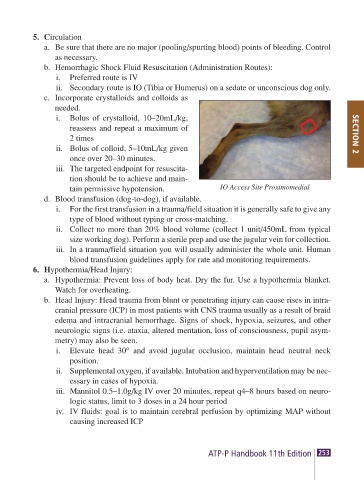
             ii.  Secondary route is IO (Tibia or Humerus) on a sedate or unconscious dog only.
           c.  Incorporate crystalloids and colloids as
             needed.
             i.  Bolus of crystalloid, 10–20mL/kg,
                reassess and repeat a maximum of
                2 times                                                       SECTION 2
             ii.  Bolus of colloid, 5–10mL/kg given
                once over 20–30 minutes.
             iii.  The targeted endpoint for resuscita-
                tion should be to achieve and main-
                tain permissive hypotension.     IO Access Site Proximomedial
           d.  Blood transfusion (dog-to-dog), if available.
             i.  For the first transfusion in a trauma/field situation it is generally safe to give any
                type of blood without typing or cross-matching.
             ii.  Collect no more than 20% blood volume (collect 1 unit/450mL from typical
                size working dog). Perform a sterile prep and use the jugular vein for collection.
             iii.  In a trauma/field situation you will usually administer the whole unit. Human
                blood transfusion guidelines apply for rate and monitoring requirements.
        6.   Hypothermia/Head Injury:
           a.  Hypothermia: Prevent loss of body heat. Dry the fur. Use a hypothermia blanket.
             Watch for overheating.
           b.  Head Injury: Head trauma from blunt or penetrating injury can cause rises in intra-
             cranial pressure (ICP) in most patients with CNS trauma usually as a result of braid
             edema and intracranial hemorrhage. Signs of shock, hypoxia, seizures, and other
             neurologic signs (i.e. ataxia, altered mentation, loss of consciousness, pupil asym-
             metry) may also be seen.
             i.   Elevate head 30° and avoid jugular occlusion, maintain head neutral neck
                position.
             ii.   Supplemental oxygen, if available. Intubation and hyperventilation may be nec-
                essary in cases of hypoxia.
             iii.  Mannitol 0.5–1.0g/kg IV over 20 minutes, repeat q4–8 hours based on neuro-
                logic status, limit to 3 doses in a 24 hour period
             iv.   IV fluids: goal is to maintain cerebral perfusion by optimizing MAP without
                causing increased ICP


   252  SECTION 2   TACTICAL MEDICAL EMERGENCY PROTOCOLS (TMEPs)     ATP-P Handbook 11th Edition 253

