


Page 262 - ATP-P 11th Ed
P. 262
NOT apply a muzzle. If a muzzle is placed on the dog it must be monitored at all
             times and removed at the first sign of overheating or vomiting because they can eas-
             ily aspirate. Get help, if possible from someone who can help hold the dog, so you
             can do an examination and/or treat the dog.
             i.  Carefully pull the tongue out of the animal’s mouth.
             ii.    Even an unresponsive dog may bite by instinct!!
             iii.   Make sure that the neck is reasonably straight; try to bring the head in-line with
                the neck.
   SECTION 2  b.  Intubation or tracheostomy if necessary to secure airway.
             iv.
                    Do not hyperextend in cases where neck trauma exists.
                    Do not attempt to intubate or perform a tracheostomy on a conscious ani-
             i.
                mal, personnel must have prior training. ET tube size can range from 7–10.
           c.   If intubation is not possible, then attempt tracheotomy.
           d.   After achieving a patent airway, one must determine whether the animal is breath-
             ing, and whether this breathing is effective.
           e.  AIRWAY CONSIDERATIONS:
             i.   Size 7mm to 10mm cuffed endotracheal tube, secure with gauze or IV tubing.
                Tie over nose.
             ii.  Blow by oxygen – secure airline to muzzle.
             iii.  Field expedient O  masks
                             2
             iv.   Nasal trumpets are ineffective in canines
        4.  Respiration
           a.  Look, Listen, and Feel
           b.   If not breathing, ventilate the animal
             by closing the mouth, and performing
             mouth-to-nose ventilations. If patient is
             intubated or has tracheostomy, ventilate
             the animal using a BVM.
           c.   Ventilate at 20 breaths per  minute.
           d.   If available, use supplemental oxygen.
           e.  Chest seal: Human chest seals can be
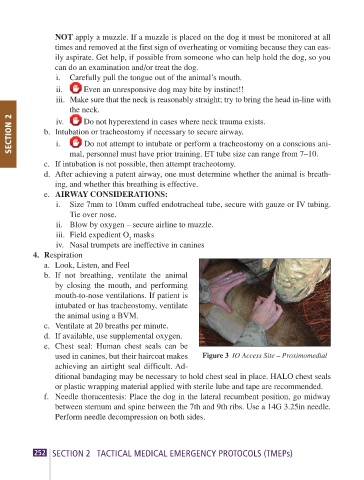
             used in canines, but their haircoat makes   Figure 3  IO Access Site – Proximomedial
             achieving an airtight seal difficult. Ad-
             ditional bandaging may be necessary to hold chest seal in place. HALO chest seals
             or plastic wrapping material applied with sterile lube and tape are recommended.
           f.  Needle thoracentesis: Place the dog in the lateral recumbent position, go midway
             between sternum and spine between the 7th and 9th ribs. Use a 14G 3.25in needle.
             Perform needle decompression on both sides.


          252  SECTION 2   TACTICAL MEDICAL EMERGENCY PROTOCOLS (TMEPs)                                                       ATP-P Handbook 11th Edition 253

