


Page 81 - 2026 SMOG
P. 81
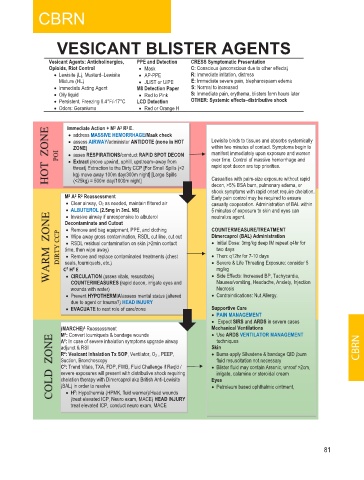
CBRN CASUALTY MANAGEMENT
                                   Basic Principles
         Approach the initial care of the CBRN casualty in the same manner as other casualties. Life
         threats require prompt recognition and intervention, and nonlifethreatening sequelae can be
         addressed when clinically appropriate. Early recognition and categorization of CBRN-exposed
         patients is the foundation for further management and is key not only for initiating patient
         treatment but also for preventing contamination of medical personnel, equipment, and facilities.
         Thorough and appropriate decontamination is a core skill that requires planning and practice.
         Attention to detail, such as preventing hypothermia in patients undergoing decontamination
         and clinical reassessment at each stage of the process, will reduce unnecessary morbidity. Basic
         lifesaving measures such as airway management and resuscitation are fundamental concepts that
         must be mastered at the appropriate level for each practitioner in the CBRN care chain.
                                CBRN Critical Task List
          1.  Recognize CBRN exposure that requires action to protect self and others.
          2.  Don personal protective equipment (PPE) to prevent exposure for oneself and assist others
            with PPE.
          3.  Egress from the threat:
            a. Move upwind, uphill, upstream from the threat.
            b. Utilize time/distance/shielding for protection.
          4.  Recognize signs/symptoms of CBRN exposure that prompt immediate self treatment or treat-
            ment of others utilizing CRESS assessment. (RAPID IDENTIFICATION OF CHEMICAL
            WARFARE AGENTS).
          5.  Apply TCCC integrated with CBRN response TCCC + CBRN = (MARCHE) 2
          6.  Apply airway management skills in a CBRN setting (positioning, suction, ventilation, includ-
            ing manual and mechanical, placement of definitive airway)
          7.  Perform Rapid SpO  Decontamination.
                         2
          8.  Identify and establish Hot/Warm/Cold Zones.
          9.  Establish a dirty casualty collection point (CCP).
         10.  Understand decontamination principles and casualty procedures for partial or complete
            removal of PPE, clothing, and equipment (casualty cut out).
         11.  Understand crosscontamination and take appropriate measures to prevent it.
         12.  Understand available technology that can aid in agent identification.
                        CBRN Medical Regulating Considerations
         1. Military Treatment Facility (MTF).
           a.  DECON/Treatment Coordination. Ensure MTF is prepared to receive dirty casualties and
             determine the most appropriate location for DECON.
           b.  Treatment Capabilities (Toxicology, Critical Care, Trauma Surgery). Determine whether the
             MTF has the services necessary to care for and sustain the CBRN casualty on site and/or
             establish telemedicine support.
           c.  Capacity. The CBRN casualty is far more resourceintensive than a typical trauma or
             critically ill casualty. Assess the MTF’s capacity and capability to treat CBRN casualties and
             identify potential alternate locations.
         2. Integrate the medical regulating system into CBRN casualty evacuation.
                                                                   (continues)


                           2026 Standard Medical Operating Guidelines (SMOG)  •   73

