


Page 79 - 2026 SMOG
P. 79
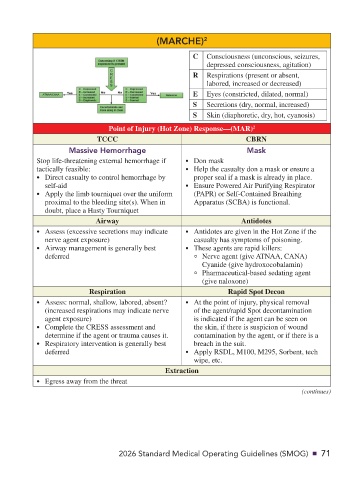
(MARCHE)  2
                                           C  Consciousness (unconscious, seizures,
                                              depressed consciousness, agitation)
                                           R  Respirations (present or absent,
                                              labored, increased or decreased)
                                           E  Eyes (constricted, dilated, normal)
                                           S  Secretions (dry, normal, increased)
                                           S  Skin (diaphoretic, dry, hot, cyanosis)
                         Point of Injury (Hot Zone) Response—(MAR) 2
                      TCCC                             CBRN
                Massive Hemorrhage                     Mask
         Stop life-threatening external hemorrhage if   •  Don mask
         tactically feasible:            •  Help the casualty don a mask or ensure a
         •  Direct casualty to control hemorrhage by   proper seal if a mask is already in place.
           self-aid                      •  Ensure Powered Air Purifying Respirator
         •  Apply the limb tourniquet over the uniform   (PAPR) or Self-Contained Breathing
           proximal to the bleeding site(s). When in   Apparatus (SCBA) is functional.
           doubt, place a Hasty Tourniquet
                      Airway                          Antidotes
         •  Assess (excessive secretions may indicate   •  Antidotes are given in the Hot Zone if the
           nerve agent exposure)           casualty has symptoms of poisoning.
         •  Airway management is generally best   •  These agents are rapid killers:
           deferred                           ˚  Nerve agent (give ATNAA, CANA)
                                             Cyanide (give hydroxocobalamin)
                                              ˚  Pharmaceutical-based sedating agent
                                             (give naloxone)
                    Respiration                    Rapid Spot Decon
         •  Assess: normal, shallow, labored, absent?   •  At the point of injury, physical removal
           (increased respirations may indicate nerve   of the agent/rapid Spot decontamination
           agent exposure)                 is indicated if the agent can be seen on
         •  Complete the CRESS assessment and   the skin, if there is suspicion of wound
           determine if the agent or trauma causes it.  contamination by the agent, or if there is a
         •  Respiratory intervention is generally best   breach in the suit.
           deferred                      •  Apply RSDL, M100, M295, Sorbent, tech
                                           wipe, etc.
                                     Extraction
         •  Egress away from the threat
                                                                   (continues)


                           2026 Standard Medical Operating Guidelines (SMOG)  •   71

