


Page 48 - 2026 SMOG
P. 48
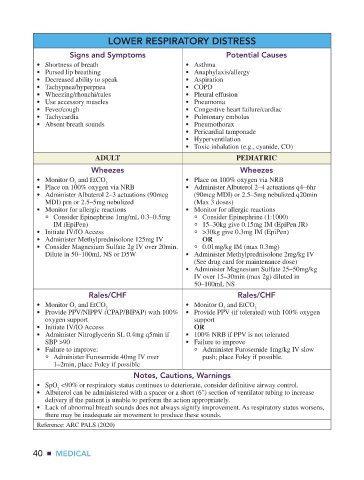
LOWER RESPIRATORY DISTRESS
                Signs and Symptoms                Potential Causes
         •  Shortness of breath          •  Asthma
         •  Pursed lip breathing         •  Anaphylaxis/allergy
         •  Decreased ability to speak   •  Aspiration
         •  Tachypnea/hyperpnea          •  COPD
         •  Wheezing/rhonchi/rales       •  Pleural effusion
         •  Use accessory muscles        •  Pneumonia
         •  Fever/cough                  •  Congestive heart failure/cardiac
         •  Tachycardia                  •  Pulmonary embolus
         •  Absent breath sounds         •  Pneumothorax
                                         •  Pericardial tamponade
                                         •  Hyperventilation
                                         •  Toxic inhalation (e.g., cyanide, CO)
                      ADULT                         PEDIATRIC
                     Wheezes                         Wheezes
         •  Monitor O  and EtCO 2        •  Place on 100% oxygen via NRB
                 2
         •  Place on 100% oxygen via NRB  •  Administer Albuterol 2–4 actuations q4–6hr
         •  Administer Albuterol 2–3 actuations (90mcg   (90mcg MDI) or 2.5–5mg nebulized q20min
           MDI) prn or 2.5–5mg nebulized   (Max 3 doses)
         •  Monitor for allergic reactions  •  Monitor for allergic reactions
              ˚  Consider Epinephrine 1mg/mL 0.3–0.5mg     ˚  Consider Epinephrine (1:1000)
             IM (EpiPen)
                                             15–30kg give 0.15mg IM (EpiPen JR)
         •  Initiate IV/IO Access             ˚   ˚  >30kg give 0.3mg IM (EpiPen)
         •  Administer Methylprednisolone 125mg IV  OR
         •  Consider Magnesium Sulfate 2g IV over 20min.     ˚  0.01mg/kg IM (max 0.3mg)
           Dilute in 50–100mL NS or D5W  •  Administer Methylprednisolone 2mg/kg IV
                                           (See drug card for maintenance dose)
                                         •  Administer Magnesium Sulfate 25–50mg/kg
                                           IV over 15–30min (max 2g) diluted in
                                           50–100mL NS
                    Rales/CHF                        Rales/CHF
         •  Monitor O  and EtCO 2        •  Monitor O  and EtCO 2
                 2
                                                  2
         •  Provide PPV/NIPPV (CPAP/BIPAP) with 100%  •  Provide PPV (if tolerated) with 100% oxygen
           oxygen support                  support
         •  Initiate IV/IO Access          OR
         •  Administer Nitroglycerin SL 0.4mg q5min if   •  100% NRB if PPV is not tolerated
           SBP >90                       •  Failure to improve
         •  Failure to improve:               ˚  Administer Furosemide 1mg/kg IV slow
              ˚  Administer Furosemide 40mg IV over   push; place Foley if possible.
             1–2min, place Foley if possible
                              Notes, Cautions, Warnings
         •  SpO  <90% or respiratory status continues to deteriorate, consider definitive airway control.
              2
         •  Albuterol can be administered with a spacer or a short (6") section of ventilator tubing to increase
           delivery if the patient is unable to perform the action appropriately.
         •  Lack of abnormal breath sounds does not always signify improvement. As respiratory status worsens,
           there may be inadequate air movement to produce these sounds.
         Reference: ARC PALS (2020)
        40  •   MEDICAL

