


Page 21 - 2026 SMOG
P. 21
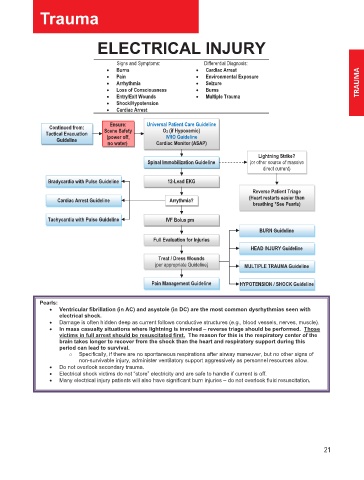
IV/IO
         •  Assess the need for IV       •  IO device for life/limb threatening conditions
              ˚  Emergent or potentially emergent medical  •  Consider IO only if the patient is deemed
             or trauma condition
                                           difficult to gain IV access
         •  Peripheral IV ×2             •  If IV/IO access is unsuccessful, consider
              ˚  Catheter ≥18G             External Jugular (EJ) cannulation
              ˚  Two failed attempts or >90 seconds,
             proceed to IO
         •  Sternal IO device by precedence:  •  Correct needle size for EZ-IO
              ˚  Fast1                        ˚  Yellow—45 mm for adult (>40kg)
              ˚  EZ T.A.L.O.N                humerus
                                             Blue—25 mm for adult (>40kg) tibia
              ˚
             EZ-IO
         •  Locations for EZ T.A.L.O.N and EZ IO by     ˚   ˚  Pink—15 mm for pediatrics (3–39kg) and
           precedence:                       adult tibia
              ˚  Bilateral proximal humerus
              ˚  Bilateral proximal or distal tibia
              ˚  Bilateral distal femur
                              Notes, Cautions, Warnings
         •  Gain vascular access where available based on the patient.
         •  Give any pre-hospital fluids or medications approved for IV use through an IO line, including
           blood products.
         •  All trauma patients or potentially ill patients should have at least two functioning IV/IO lines
           whenever possible.
         •  Upper extremity IV sites are preferable to lower extremity IV sites.
         •  A pressure infusion bag is recommended for IO starting at 300mmHg.
         •  Following IV attempt failure and IO attempt failure, attempt external jugular lines for life-
           threatening events with no peripheral access.
         •  Ensure an open and functioning fluid bolus per specific protocol. At a minimum, maintain a
           slow “to-keep-open” (TKO) drip.


                           2026 Standard Medical Operating Guidelines (SMOG)  •   13

