


Page 151 - 2025 Ranger Medic Handbook
P. 151
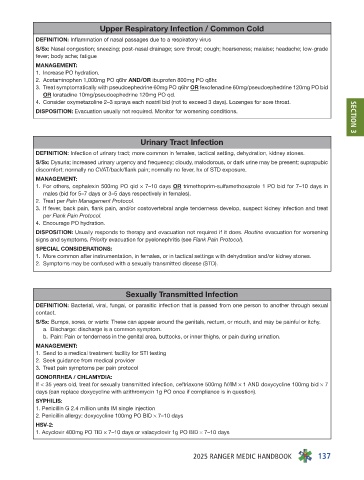
Upper Respiratory Infection / Common Cold
         DEFINITION: Inflammation of nasal passages due to a respiratory virus
         S/Sx: Nasal congestion; sneezing; post-nasal drainage; sore throat; cough; hoarseness; malaise; headache; low-grade
         fever; body ache; fatigue
         MANAGEMENT:
         1.  Increase PO hydration.
         2.  Acetaminophen 1,000mg PO q6hr AND/OR ibuprofen 800mg PO q8hr.
         3.  Treat symptomatically with pseudoephedrine 60mg PO q6hr OR fexofenadine 60mg/pseudoephedrine 120mg PO bid
          OR loratadine 10mg/pseudoephedrine 120mg PO qd.
         4.  Consider oxymetazoline 2–3 sprays each nostril bid (not to exceed 3 days). Lozenges for sore throat.
         DISPOSITION: Evacuation usually not required. Monitor for worsening conditions.  SECTION 3


                                Urinary Tract Infection
         DEFINITION: Infection of urinary tract; more common in females, tactical setting, dehydration, kidney stones.
         S/Sx: Dysuria; increased urinary urgency and frequency; cloudy, malodorous, or dark urine may be present; suprapubic
         discomfort; normally no CVAT/back/flank pain; normally no fever, hx of STD exposure.
         MANAGEMENT:
         1.  For others, cephalexin 500mg PO qid × 7–10 days OR trimethoprim-sulfamethoxazole 1 PO bid for 7–10 days in
          males (bid for 5–7 days or 3–5 days respectively in females).
         2.  Treat per Pain Management Protocol.
         3.  If fever, back pain, flank pain, and/or costovertebral angle tenderness develop, suspect kidney infection and treat
          per Flank Pain Protocol.
         4.  Encourage PO hydration.
         DISPOSITION: Usually responds to therapy and evacuation not required if it does. Routine evacuation for worsening
         signs and symptoms. Priority evacuation for pyelonephritis (see Flank Pain Protocol).
         SPECIAL CONSIDERATIONS:
         1.  More common after instrumentation, in females, or in tactical settings with dehydration and/or kidney stones.
         2.  Symptoms may be confused with a sexually transmitted disease (STD).


                            Sexually Transmitted Infection
         DEFINITION: Bacterial, viral, fungal, or parasitic infection that is passed from one person to another through sexual
         contact.
         S/Sx: Bumps, sores, or warts: These can appear around the genitals, rectum, or mouth, and may be painful or itchy.
          a.  Discharge: discharge is a common symptom.
          b.  Pain: Pain or tenderness in the genital area, buttocks, or inner thighs, or pain during urination.
         MANAGEMENT:
         1.  Send to a medical treatment facility for STI testing
         2.  Seek guidance from medical provider
         3.  Treat pain symptoms per pain protocol
         GONORRHEA / CHLAMYDIA:
         If < 35 years old, treat for sexually transmitted infection, ceftriaxone 500mg IV/IM × 1 AND doxycycline 100mg bid × 7
         days (can replace doxycycline with azithromycin 1g PO once if compliance is in question).
         SYPHILIS:
         1. Penicillin G 2.4 million units IM single injection
         2. Penicillin allergy: doxycycline 100mg PO BID × 7–10 days
         HSV-2:
         1. Acyclovir 400mg PO TID × 7–10 days or valacyclovir 1g PO BID × 7–10 days


                                           2025 RANGER MEDIC HANDBOOK  137

