


Page 146 - 2025 Ranger Medic Handbook
P. 146
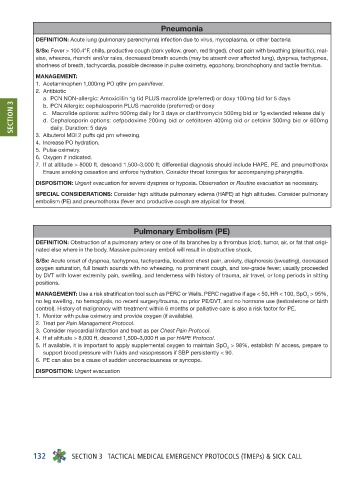
Pneumonia
         DEFINITION: Acute lung (pulmonary parenchyma) infection due to virus, mycoplasma, or other bacteria
         S/Sx: Fever > 100.4°F, chills, productive cough (dark yellow, green, red tinged), chest pain with breathing (pleuritic), mal-
         aise, wheezes, rhonchi and/or rales, decreased breath sounds (may be absent over affected lung), dyspnea, tachypnea,
         shortness of breath, tachycardia, possible decrease in pulse oximetry, egophony, bronchophony and tactile fremitus.
         MANAGEMENT:
         1.  Acetaminophen 1,000mg PO q6hr prn pain/fever.
         2.  Antibiotic
          a.  PCN NON-allergic: Amoxicillin 1g tid PLUS macrolide (preferred) or doxy 100mg bid for 5 days
    SECTION 3  c.   Macrolide options: azithro 500mg daily for 3 days or clarithromycin 500mg bid or 1g extended release daily
          b.  PCN Allergic: cephalosporin PLUS macrolide (preferred) or doxy
          d.  Cephalosporin options: cefpodoxime 200mg bid or cefditoren 400mg bid or cefdinir 300mg bid or 600mg
            daily. Duration: 5 days
         3.  Albuterol MDI 2 puffs qid prn wheezing.
         4.  Increase PO hydration.
         5.  Pulse oximetry.
         6.  Oxygen if indicated.
         7.  If at altitude > 8000 ft, descend 1,500–3,000 ft; differential diagnosis should include HAPE, PE, and pneumothorax
          Ensure smoking cessation and enforce hydration. Consider throat lozenges for accompanying pharyngitis.
         DISPOSITION: Urgent evacuation for severe dyspnea or hypoxia. Observation or Routine evacuation as necessary.
         SPECIAL CONSIDERATIONS: Consider high altitude pulmonary edema (HAPE) at high altitudes. Consider pulmonary
         embolism (PE) and pneumothorax (fever and productive cough are atypical for these).


                              Pulmonary Embolism (PE)
         DEFINITION: Obstruction of a pulmonary artery or one of its branches by a thrombus (clot), tumor, air, or fat that origi-
         nated else where in the body. Massive pulmonary emboli will result in obstructive shock.
         S/Sx: Acute onset of dyspnea, tachypnea, tachycardia, localized chest pain, anxiety, diaphoresis (sweating), decreased
         oxygen saturation, full breath sounds with no wheezing, no prominent cough, and low-grade fever; usually proceeded
         by DVT with lower extremity pain, swelling, and tenderness with history of trauma, air travel, or long periods in sitting
         positions.
         MANAGEMENT: Use a risk stratification tool such as PERC or Wells. PERC negative if age < 50, HR < 100, SpO 2  > 95%,
         no leg swelling, no hemoptysis, no recent surgery/trauma, no prior PE/DVT, and no hormone use (testosterone or birth
         control). History of malignancy with treatment within 6 months or palliative care is also a risk factor for PE.
         1.  Monitor with pulse oximetry and provide oxygen (if available).
         2.  Treat per Pain Management Protocol.
         3.  Consider myocardial Infarction and treat as per Chest Pain Protocol.
         4.  If at altitude > 8,000 ft, descend 1,500–3,000 ft as per HAPE Protocol.
         5.  If available, it is important to apply supplemental oxygen to maintain SpO 2  > 98%, establish IV access, prepare to
          support blood pressure with fluids and vasopressors if SBP persistently < 90.
         6.  PE can also be a cause of sudden unconsciousness or syncope.
         DISPOSITION: Urgent evacuation


        132      SECTION 3   TACTICAL MEDICAL EMERGENCY PROTOCOLS (TMEPs) & SICK CALL

