


Page 56 - JSOM Spring 2026
P. 56
14
                                                                   23
          Urban Rush (RUSH) was proposed for  Australian PTGs.    reliable.  Body mass was measured on a Tanita BC82Fitplus
          This assessment has undergone several studies to investigate   (Tanita Corporation, Tokyo, Japan) scale by the unit’s head
                                                         15
          the relationship between the assessment, measures of fitness,    strength and conditioning coach, with participants both in
          and PTG candidate selection success, along with other se-  athletic clothing (body mass) and with their full PPE. The offi-
                               16
          lection outcome measures.   The RUSH represents a short-   cer’s measurements were recorded in kilograms to the nearest
          duration, explosive task involving rapid movement between   100g. The BMI of the officers was calculated using the stan-
                                                                                                2
          cover zones and recovery of injured personnel, while ensuring   dard equation (BMI=weight (kg)/[height (m)] ).
          tactical protection (e.g., weapon raised and aligned to target
                      14
          when stopped).  This assessment is conducted in full personal   RUSH Protocol
          protective equipment (PPE; inclusive of primary and second-  The RUSH has been described previously. 15,16  The RUSH was
          ary weapon systems, ammunition, body armor, helmet, com-  conducted on a dry, non-slip rubber gym flooring surface, with
          munications systems, etc.) to replicate the demands placed on   10- and 20-meter distances marked with a tape measure and
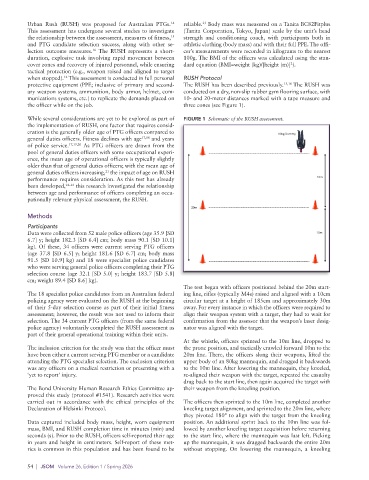
          the officer while on the job.                      three cones (see Figure 1).
          While several considerations are yet to be explored as part of   FIGURE 1  Schematic of the RUSH assessment.
          the implementation of RUSH, one factor that requires consid-
          eration is the generally older age of PTG officers compared to                    80kg Dummy
          general duties officers. Fitness declines with age 17,18  and years
          of police service. 17,19,20  As PTG officers are drawn from the
          pool of general duties officers with some occupational experi-
          ence, the mean age of operational officers is typically slightly
          older than that of general duties officers; with the mean age of
                                   21
          general duties officers increasing,  the impact of age on RUSH
          performance requires consideration. As this test has already                                   10m
          been developed, 14–16  this research investigated the relationship
          between age and performance of officers completing an occu-
          pationally relevant physical assessment, the RUSH.
                                                               20m
          Methods

          Participants
          Data were collected from 52 male police officers (age 35.9 [SD                                10m
          6.7] y; height 182.3 [SD 6.4] cm; body mass 90.1 [SD 10.1]
          kg). Of these, 34 officers were current serving PTG officers
          (age 37.8 [SD 6.5] y; height 181.6 [SD 6.7] cm; body mass
          91.5 [SD 10.9] kg) and 18 were specialist police candidates
          who were serving general police officers completing their PTG
          selection course (age 32.1 [SD 5.0] y; height 183.7 [SD 5.8]
          cm; weight 89.4 [SD 8.6] kg).
                                                             The test began with officers positioned behind the 20m start-
          The 18 specialist police candidates from an Australian federal   ing line, rifles (typically M4s) raised and aligned with a 10cm
          policing agency were evaluated on the RUSH at the beginning   circular target at a height of 185cm and approximately 30m
          of their 5-day selection course as part of their initial fitness   away. For every instance in which the officers were required to
          assessment; however, the result was not used to inform their   align their weapon system with a target, they had to wait for
          selection. The 34 current PTG officers (from the same federal   confirmation from the assessor that the weapon’s laser desig-
          police agency) voluntarily completed the RUSH assessment as   nator was aligned with the target.
          part of their general operational training within their units.
                                                             At the whistle, officers sprinted to the 10m line, dropped to
          The inclusion criterion for the study was that the officer must   the prone position, and tactically crawled forward 10m to the
          have been either a current serving PTG member or a candidate   20m line. There, the officers slung their weapons, lifted the
          attending the PTG specialist selection. The exclusion criterion   upper body of an 80kg mannequin, and dragged it backwards
          was any officers on a medical restriction or presenting with a   to the 10m line. After lowering the mannequin, they kneeled,
          ‘yet to report’ injury.                            re-aligned their weapon with the target, repeated the casualty
                                                             drag back to the start line, then again acquired the target with
          The Bond University Human Research Ethics Committee ap-  their weapon from the kneeling position.
          proved this study (protocol #1541). Research activities were
          carried out in accordance with the ethical principles of the   The officers then sprinted to the 10m line, completed another
          Declaration of Helsinki Protocol.                  kneeling target alignment, and sprinted to the 20m line, where
                                                             they pivoted 180° to align with the target from the kneeling
          Data captured included body mass, height, worn equipment   position. An additional sprint back to the 10m line was fol-
          mass, BMI, and RUSH completion time in minutes (min) and   lowed by another kneeling target acquisition before returning
          seconds (s). Prior to the RUSH, officers self-reported their age   to the start line, where the mannequin was last left. Picking
          in years and height in centimeters. Self-report of these met-  up the mannequin, it was dragged backwards the entire 20m
          rics is common in this population and has been found to be   without stopping. On lowering the mannequin, a kneeling

          54  |  JSOM   Volume 26, Edition 1 / Spring 2026

