


Page 10 - JSOM Spring 2026
P. 10
FEATURE ARTICLES                                   tightening-system rotation were lower, and completion of
          Perceived Performance Traits of Blood Warming Devices   tightening-system use after first completion was faster with
          Among Special Warfare Medics: Williams and colleagues sur-  the X8T-T2G system.
                           veyed a convenience sample of 35 Naval
                           Special  Warfare Corpsmen about the   The STEP Method: A Structured Approach to Optimize Team
                           perceived usability of five blood warmer   Performance of Army Forward Resuscitative Surgical De-
                           devices: the QinFlow, M Warmer, Buddy   tachments (FRSDs): With the aim of optimizing performance
                           Lite,  Thermal  Angel, and the  North   within the U.S. Army Forward Resuscitative Surgical Detach-
                           American Rescue (NAR) Quantum. The   ment (FRSD), Bongartz and colleagues designed a theoretical
                           M Warmer received the highest overall   framework based on literature and interdisciplinary expert
                           scores in all three domains evaluated—  input. The STEP method combines Skill, Team organization,
                           ease of use, device ruggedness, and   Equipment, and Process in its standardized approach to high-
                           perceived device efficacy—as well as   stress, high-stakes environments.  The authors contend that
          positive qualitative feedback. The authors conclude that these   this method introduces a standardized approach to trauma
          strong findings underscore the importance of integrating end-  resuscitation by Army FRSDs, offering a replicable SOP tem-
          user feedback into medical equipment acquisition.  plate with broad applicability across Army medical units.
          First Island Chain Experiences Using Team Awareness Kit   Relationship Between Age and Performance of Police Tactical
          (TAK) for Medical Communications: Brust and colleagues de-  Group Candidates and Officers Completing an Occupationally
          scribe two examples of Team Awareness Kit (TAK) use from   Relevant Specialist Police Physical Assessment:  Using retro-
          exercises with III Marine Expeditionary Force in the Indo-   spective data from 34 male Police Tactical Group (PTG) officers
          Pacific. In these scenarios, TAK—a software that can be used   completing the RUSH assessment, Irving and colleagues inves-
          in the field to see maps, share locations, and maintain situa-  tigated the relationship between officer age and completion
          tional awareness—proved to be a low-cost, effective tool for   times for an occupationally relevant physical fitness assessment
          medical command and control, and should be further consid-  in specialist police officers. The researchers found that age was
          ered for adoption across Joint and Partner Forces.  not a significant predictor of RUSH times and that ongoing
                                                             physical strength and conditioning practices undertaken by
                                                             PTG officers may mitigate age-related fitness loss.
                                                             AI-Assisted Lung Sliding Detection in Point-of-Care Ultra-
                                                             sound by Marine Corps Corpsmen: A Multi-Reader Study:
                                                             In  this  pilot-prospective  multi-reader,  multi-case  study,  Côté
                                                             and colleagues evaluated whether AI-based decision support
                                                             could improve the diagnostic accuracy and confidence of U.S.
                                                             Marine Corps Corpsmen in identifying absent lung sliding.
                                                             Five military medics, all novices in point-of-care ultrasound,
                                                             each interpreted 50 de-identified lung ultrasound video clips
                                                             twice, once without AI assistance and once with AI assistance,
                                                             in randomized order with at least a 2-hour washout between
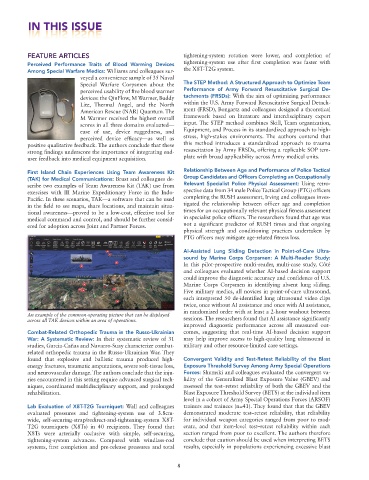
          An example of the common operating picture that can be displayed
          across all TAK devices within an area of operations.  sessions. The researchers found that AI assistance significantly
                                                             improved diagnostic performance  across all measured out-
          Combat-Related Orthopedic Trauma in the Russo-Ukrainian     comes, suggesting that real-time  AI-based decision support
          War: A Systematic Review: In their systematic review of 31   may help improve access to high-quality lung ultrasound in
          studies, Garcia-Cañas and Navarro-Suay characterize combat-   military and other resource-limited care settings.
          related orthopedic trauma in the Russo-Ukrainian War. They
          found that explosive and ballistic trauma produced high-   Convergent Validity and Test-Retest Reliability of the Blast
          energy fractures, traumatic amputations, severe soft-tissue loss,   Exposure Threshold Survey Among Army Special Operations
          and neurovascular damage. The authors conclude that the inju-  Forces: Shumski and colleagues evaluated the convergent va-
          ries encountered in this setting require advanced surgical tech-  lidity  of  the  Generalized  Blast  Exposure Value  (GBEV)  and
          niques, coordinated multidisciplinary support, and prolonged   assessed the test–retest reliability of both the GBEV and the
          rehabilitation.                                    Blast Exposure Threshold Survey (BETS) at the individual item
                                                             level in a cohort of Army Special Operations Forces (ARSOF)
          Lab Evaluation of X8T-T2G Tourniquet: Wall and colleagues   trainers and trainees (n=41). They found that that the GBEV
          evaluated pressures and tightening-system use of 3.8cm-   demonstrated moderate test–retest reliability, that reliability
          wide,  self-securing-strap/redirect-and-tightening-system  X8T-  for individual weapon categories ranged from poor to mod-
          T2G tourniquets (X8Ts) in 40 recipients.  They found that   erate, and that item-level test–retest reliability within each
          X8Ts  were  arterially  occlusive  with  simple,  self-securing,   section ranged from poor to excellent. The authors therefore
          tightening-system advances. Compared with windlass-rod   conclude that caution should be used when interpreting BETS
          systems, first completion and pre-release pressures and total   results, especially in populations experiencing excessive blast


                                                           8

