


Page 70 - JSOM Winter 2024
P. 70
standard deviations (SDs). There were no missing data. The    TABLE 1  Demographics of Course Participants
          t test was used to assess differences with parametric continuous                        No. (%) of
          data. All tests were two-tailed, and a P value of <.05 was used                         participants;
          to define statistical significance. All tests were performed in                           n=12
          Stata version 17 (StataCorp, College Station, TX) and Graph-  Sex
          Pad Prism 7.0 for Mac (GraphPad Software, La Jolla, CA).  Male                            8 (67)
                                                              Age, y
          Given  active duty  SOST  requirements,  12 qualified  partici-
          pants were the maximum number that could attend the train-  21–30                          1 (8)
          ing. A post-hoc power analysis was performed. The study was   31–40                       10 (84)
          found to be appropriately powered to detect a statistically sig-  41–50                    1 (8)
          nificant difference between knowledge assessments and self-   AFSC
          assessments before and after the course.            45S (General Surgeon)                 2 (17)
                                                              44E (Emergency Physician)              1 (8)
          Results                                             46M/45A (Nurse Anesthetist/Anesthesiologist)  4 (33)
                                                              46N (Critical Care Nurse)             2 (17)
          Characteristics and Background of Course Participants  ED                                 1 (50)
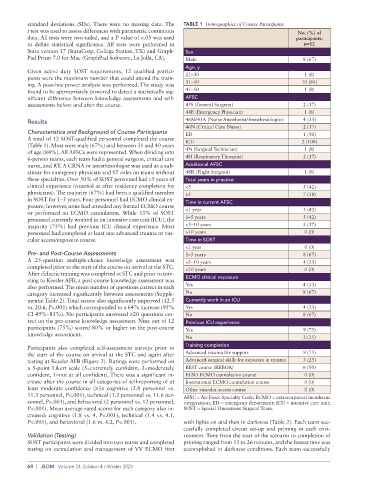
          A total of 12 SOST-qualified personnel completed the course   ICU                         2 (100)
          (Table 1). Most were male (67%) and between 31 and 40 years
          of age (84%). All AFSCs were represented. When dividing into   4N (Surgical Technician)    1 (8)
          6-person teams, each team had a general surgeon, critical care   4H (Respiratory Therapist)  2 (17)
          nurse, and RT. A CRNA or anesthesiologist was used as a sub-  Additional AFSC
          stitute for emergency physician and ST roles on teams without   48R (Flight Surgeon)       1 (8)
          these specialties. Over 50% of SOST personnel had ≥5 years of   Total years in practice
          clinical experience (counted as after residency completion for   <5                       5 (42)
          physicians). The majority (67%) had been a qualified member   ≥5                          7 (58)
          in SOST for 1–5 years. Four personnel had ECMO clinical ex-  Time in current AFSC
          posure; however, none had attended any formal ECMO course
          or  performed  an  ECMO  cannulation. While  33%  of  SOST   <1 year                      5 (42)
          personnel currently worked in an intensive care unit (ICU), the   1–5 years               5 (42)
          majority (75%) had previous ICU clinical experience. Most   >5–10 years                   2 (17)
          personnel had completed at least one advanced trauma or vas-  >10 years                    0 (0)
          cular access/exposure course.                       Time in SOST
                                                              <1 year                                0 (0)
          Pre- and Post-Course Assessments                    1–5 years                             8 (67)
          A 25-question  multiple-choice  knowledge  assessment  was   >5–10 years                  4 (33)
          completed prior to the start of the course on arrival at the STC.   >10 years              0 (0)
          After didactic training was completed at STC and prior to trav-
          eling to Keesler AFB, a post-course knowledge assessment was   ECMO clinical exposure
          also performed. The mean number of questions correct in each   Yes                        4 (33)
          category increased significantly between assessments (Supple-  No                         8 (67)
          mental Table 2). Total scores also significantly improved (12.5   Currently work in an ICU
          vs. 20.6, P<.001) which corresponded to a 64% increase (95%   Yes                         4 (33)
          CI 49%–83%). No participants answered ≥20 questions cor-  No                              8 (67)
          rect on the pre-course knowledge assessment. Nine out of 12   Previous ICU experience
          participants (75%) scored 80% or higher on the post-course   Yes                          9 (75)
          knowledge assessment.
                                                              No                                    3 (25)
                                                              Training completion
          Participants also completed self-assessment surveys prior to
          the start of the course on arrival at the STC and again after   Advanced trauma life support  9 (75)
          testing at Keesler AFB (Figure 2). Ratings were performed on   Advanced surgical skills for exposure in trauma  3 (25)
          a 5-point Likert scale (5=extremely confident, 3=moderately   BEST course (REBOA)         6 (50)
          confident, 1=not at all confident). There was a significant in-  ELSO ECMO cannulation course  0 (0)
          crease after the course in all categories of self-reporting of at   Institutional ECMO cannulation course  0 (0)
          least moderate confidence (≥3): cognitive (2.8 personnel vs.   Other vascular access course  0 (0)
          11.3 personnel, P<.001), technical (1.2 personnel vs. 11.6 per-  AFSC = Air Force Specialty Code; ECMO = extracorporeal membrane
          sonnel, P<.001), and behavioral (2 personnel vs. 12 personnel,   oxygenation; ED = emergency department; ICU = intensive care unit;
          P<.001). Mean average rated scores for each category also in-  SOST = Special Operations Surgical Team.
          creased: cognitive (1.8 vs. 4, P<.001), technical (1.4 vs. 4.1,
          P<.001), and behavioral (1.6 vs. 4.2, P<.001).     with lights on and then in darkness (Table 2). Each team suc-
                                                             cessfully completed circuit set-up and priming in each envi-
          Validation (Testing)                               ronment. Time from the start of the scenario to completion of
          SOST participants were divided into two teams and completed   priming ranged from 13 to 26 minutes, and the fastest time was
          testing on cannulation and management of VV ECMO first   accomplished in darkness conditions. Each team successfully

          68  |  JSOM   Volume 24, Edition 4 / Winter 2024

