


Page 117 - JSOM Spring 2023
P. 117
anterior descending artery demonstrated a 99% stenosis and
                                                                 was treated with two stents. The circumflex artery demon-
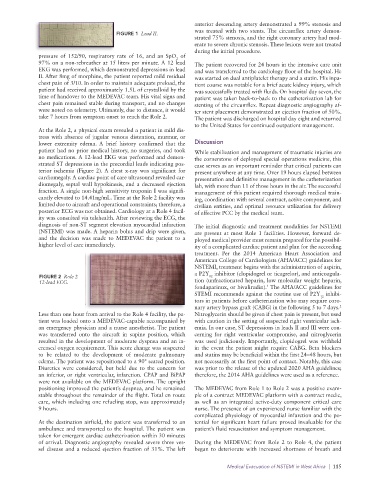
                                       FIGURE 1  Lead II.
                                                                 strated 75% stenosis, and the right coronary artery had mod-
                                                                 erate to severe chronic stenosis. These lesions were not treated
                                                                 during the initial procedure.
              pressure of 152/90, respiratory rate of 16, and an SpO  of
                                                           2
              97% on a non-rebreather at 15 liters per minute. A 12 lead   The patient recovered for 24 hours in the intensive care unit
              EKG was performed, which demonstrated depressions in lead   and was transferred to the cardiology floor of the hospital. He
              II. After 8mg of morphine, the patient reported mild residual   was started on dual antiplatelet therapy and a statin. His inpa-
              chest pain of 3/10. In order to maintain adequate preload, the   tient course was notable for a brief acute kidney injury, which
              patient had received approximately 1.5L of crystalloid by the   was successfully treated with fluids. On hospital day seven, the
              time of handover to the MEDEVAC team. His vital signs and   patient was taken back-to-back to the catheterization lab for
              chest pain remained stable during transport, and no changes   stenting of the circumflex. Repeat diagnostic angiography af-
              were noted on telemetry. Ultimately, due to distance, it would   ter stent placement demonstrated an ejection fraction of 50%.
              take 7 hours from symptom onset to reach the Role 2.   The patient was discharged on hospital day eight and returned
                                                                 to the United States for continued outpatient management.
              At the Role 2, a physical exam revealed a patient in mild dis-
              tress with absence of jugular venous distention, murmur, or
              lower extremity edema.  A brief history confirmed that the   Discussion
              patient had no prior medical history, no surgeries, and took   While stabilization and management of traumatic injuries are
              no medications. A 12-lead EKG was performed and demon-  the cornerstone of deployed special operations medicine, this
              strated ST depressions in the precordial leads indicating pos-  case serves as an important reminder that critical patients can
              terior ischemia (Figure 2). A chest x-ray was significant for   present anywhere at any time. Over 19 hours elapsed between
              cardiomegaly. A cardiac point of care ultrasound revealed car-  presentation and definitive management in the catheterization
              diomegaly, septal wall hypokinesis, and a decreased ejection   lab, with more than 11 of those hours in the air. The successful
              fraction. A single non-high sensitivity troponin I was signifi-  management of this patient required thorough medical train-
              cantly elevated to 14.41ng/mL. Time at the Role 2 facility was   ing, coordination with several contract, active component, and
              limited due to aircraft and operational constraints; therefore, a   civilian entities, and optimal resource utilization for delivery
              posterior ECG was not obtained. Cardiology at a Role 4 facil-  of effective PCC by the medical team.
              ity was consulted via telehealth. After reviewing the ECG, the
              diagnosis of non-ST segment elevation myocardial infarction   The initial diagnostic and treatment modalities for NSTEMI
              (NSTEMI) was made. A heparin bolus and drip were given,   are  present  at  most  Role 1  facilities. However,  forward  de-
              and the decision was made to MEDEVAC the patient to a   ployed medical provider must remain prepared for the possibil-
              higher level of care immediately.                  ity of a complicated cardiac patient and plan for the according
                                                                 treatment. Per the 2014  American Heart  Association and
                                                                 American College of Cardiologists (AHA/ACC) guidelines for
                                                                 NSTEMI, treatment begins with the administration of aspirin,
                                                                 a P2Y  inhibitor (clopidogrel or ticagrelor), and anticoagula-
              FIGURE 2  Role 2                                       12
              12-lead ECG.                                       tion (unfractionated heparin, low molecular weight heparin,
                                                                                        1
                                                                 fondaparinux, or bivalirudin).  The AHA/ACC guidelines for
                                                                 STEMI recommends against the routine use of P2Y  inhibi-
                                                                                                          12
                                                                 tors in patients before catheterization who may require coro-
                                                                 nary artery bypass graft (CABG) in the following 5 to 7 days.
                                                                                                                2
              Less than one hour from arrival to the Role 4 facility, the pa-  Nitroglycerin should be given if chest pain is present, but used
              tient was loaded onto a MEDEVAC-capable accompanied by   with caution in the setting of suspected right ventricular isch-
              an emergency physician and a nurse anesthetist. The patient   emia. In our case, ST depressions in leads II and III were con-
              was transferred onto the aircraft in supine position, which   cerning for right ventricular compromise, and nitroglycerin
              resulted in the development of moderate dyspnea and an in-  was used judiciously. Importantly, clopidogrel was withheld
              creased oxygen requirement. This acute change was suspected   in the event the patient might require CABG. Beta blockers
              to be related to the development of moderate pulmonary   and statins may be beneficial within the first 24–48 hours, but
              edema. The patient was repositioned to a 90° seated position.   not necessarily at the first point of contact. Notably, this case
              Diuretics were considered, but held due to the concern for   was prior to the release of the updated 2020 AHA guidelines;
              an inferior, or right ventricular, infarction. CPAP and BiPAP   therefore, the 2014 AHA guidelines were used as a reference.
              were not available on the MEDEVAC platform. The upright
              positioning improved the patient’s dyspnea, and he remained   The MEDEVAC from Role 1 to Role 2 was a positive exam-
              stable throughout the remainder of the flight. Total en route   ple of a contract MEDEVAC platform with a contract medic,
              care, which including one refueling stop, was approximately   as well as an integrated active-duty component critical care
              9 hours.                                           nurse. The presence of an experienced nurse familiar with the
                                                                 complicated physiology of myocardial infarction and the po-
              At the destination airfield, the patient was transferred to an   tential for significant heart failure proved invaluable for the
              ambulance and transported to the hospital. The patient was   patient’s fluid resuscitation and symptom management.
              taken for emergent cardiac catheterization within 30 minutes
              of arrival. Diagnostic angiography revealed severe three ves-  During the MEDEVAC from Role 2 to Role 4, the patient
              sel disease and a reduced ejection fraction of 31%. The left   began to deteriorate with increased shortness of breath and

                                                                           Medical Evacuation of NSTEMI in West Africa  |  115

