


Page 263 - 2023 SMOG Digital
P. 263
SPINAL EVALUATION &

            IMMOBILIZATION/CANADIAN C-
                       SPINE RULE (CCR)


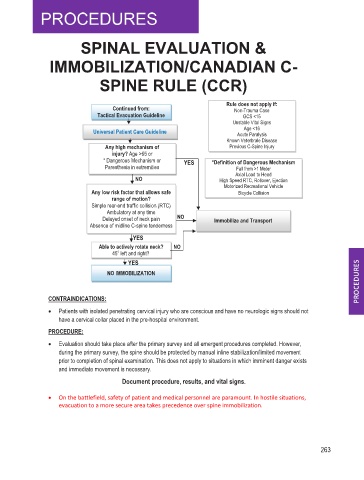
                                                  Rule does not apply if:
                          Continued from:           Non-Trauma Case
                      Tactical Evacuation Guideline   GCS <15
                                                    Unstable Vital Signs
                                                      Age <16
                     Universal Patient Care Guideline   Acute Paralysis
                                                  Known Veterbrale Disease
                        Any high mechanism of      Previous C-Spine Injury
                         injury? Age >65 or
                        * Dangerous Mechanism or  YES   *Definition of Dangerous Mechanism
                        Paresthesia in extremities  Fall from >1 Meter
                                                    Axial Load to Head
                              NO                 High Speed RTC, Rollover, Ejection
                                                  Motorized Recreational Vehicle
                     Any low risk factor that allows safe   Bicycle Collision
                         range of motion?
                     Simple rear-end traffic collision (RTC)
                        Ambulatory at any time
                       Delayed onset of neck pain   NO   Immobilize and Transport
                     Absence of midline C-spine tenderness
                              YES
                       Able to actively rotate neck?   NO
                         45 ⁰  left and right?
                             YES
                        NO IMMOBILIZATION
            CONTRAINDICATIONS:
            •  Patients with isolated penetrating cervical injury who are conscious and have no neurologic signs should not
              have a cervical collar placed in the pre-hospital environment.
            PROCEDURE:
            •  Evaluation should take place after the primary survey and all emergent procedures completed. However,
              during the primary survey, the spine should be protected by manual inline stabilization/limited movement
              prior to completion of spinal examination. This does not apply to situations in which imminent danger exists
              and immediate movement is necessary.
                            Document procedure, results, and vital signs.

            •  On the battlefield, safety of patient and medical personnel are paramount. In hostile situations,
              evacuation to a more secure area takes precedence over spine immobilization.


                                                                       263

