


Page 197 - 2023 SMOG Digital
P. 197
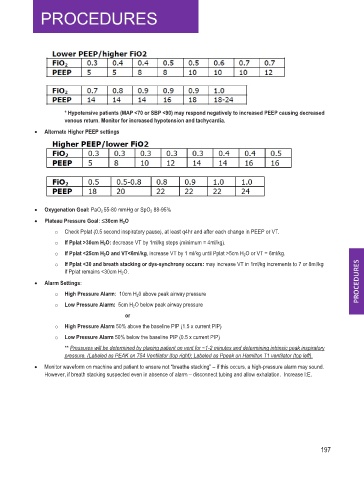
o  Set the FiO 2  to 30% and start titrating FiO 2  and PEEP collectively based on the chart to achieve oxygenation goals. Go up
           q5-10min; quicker if low SpO 2  sats develop.


               * Hypotensive patients (MAP <70 or SBP <90) may respond negatively to increased PEEP causing decreased
               venous return. Monitor for increased hypotension and tachycardia.
         •  Alternate Higher PEEP settings


         •  Oxygenation Goal: PaO 2  55-80 mmHg or SpO 2  88-95%
         •  Plateau Pressure Goal: ≤30cm H 2 O
             o  Check Pplat (0.5 second inspiratory pause), at least q4hr and after each change in PEEP or VT.
             o  If Pplat >30cm H 2 O: decrease VT by 1ml/kg steps (minimum = 4ml/kg).

             o  If Pplat <25cm H 2 O and VT<6ml/kg, increase VT by 1 ml/kg until Pplat >5cm H 2 O or VT = 6ml/kg.

             o  If Pplat <30 and breath stacking or dys-synchrony occurs: may increase VT in 1ml/kg increments to 7 or 8ml/kg
               if Pplat remains <30cm H 2 O.
         •  Alarm Settings:
             o  High Pressure Alarm:  10cm H 2 0 above peak airway pressure
             o  Low Pressure Alarm:  5cm H 2 O below peak airway pressure
                            or
             o  High Pressure Alarm 50% above the baseline PIP (1.5 x current PIP)
             o  Low Pressure Alarm 50% below the baseline PIP (0.5 x current PIP)
               ** Pressures will be determined by placing patient on vent for ~1-2 minutes and determining intrinsic peak inspiratory
               pressure. (Labeled as PEAK on 754 Ventilator (top right); Labeled as Ppeak on Hamilton T1 ventilator (top left).
         •  Monitor waveform on machine and patient to ensure not “breathe stacking” – if this occurs, a high-pressure alarm may sound.
           However, if breath stacking suspected even in absence of alarm – disconnect tubing and allow exhalation.  Increase I:E.


                                                                       197

