


Page 25 - 2022 Ranger Medic Handbook
P. 25
Care Under Fire
         Care under fire is the care rendered by the first responder or combatant at the scene of the injury while they are still
         under effective hostile fire. Available medical equipment is limited to that carried by the individual or by the medical   SECTION 1
         provider in their aid bag.
         Major goals of CUF are to move the casualty to safety, prevent further injury to the casualty and provider, stop life-
         threatening external hemorrhage, and gain and maintain fire superiority – the best medicine on the battlefield!
                                 Tactical Field Care
         Tactical field care is the care rendered by the first responder or combatant once they are no longer under effective hostile
         fire. TFC may consist of rapid treatment of the most serious wounds with the expectation of a re-engagement with hos-
         tile forces at any moment, or there may be ample time to render whatever care is possible in the field. It also applies to
         situations in which an injury has occurred but there has been no hostile fire. Available medical equipment is still limited
         to that carried into the field by unit personnel. Time to evacuation to a medical treatment facility may vary considerably.
         Remember – effective hostile fire could resume at any time.
                               Tactical Evacuation Care
         Tactical evacuation care is the care rendered once the casualty has been picked up by an aircraft, vehicle, or boat. Ad-
         ditional medical personnel and equipment that may have been pre-staged should be available in this phase of casualty
         management. The term “tactical evacuation” encompasses both casualty evacuation (CASEVAC) and medical evacu-
         ation (MEDEVAC).
                                  TCCC Concepts
         Casualty scenarios in combat usually entail both a medical problem and a tactical problem. We want the best possible
         outcome for both the casualty and the mission. Good medicine can sometimes be bad tactics; bad tactics can get
         everyone killed or cause the mission to fail. Doing the RIGHT THING at the RIGHT TIME is critical.
                              Hypotensive Resuscitation
         Goals of Fluid Resuscitation Therapy: (1) improved state of consciousness, (2) palpable radial pulse, and (3) avoid over   SECTION 6
         resuscitation of shock. Basing the titration of fluids upon a monitored physiologic response may avoid the problem of
         excessive blood pressure elevation and fatal rebleeding from previous clotted injury sites. BLOOD and blood products
         are the only fluids for trauma resuscitation.
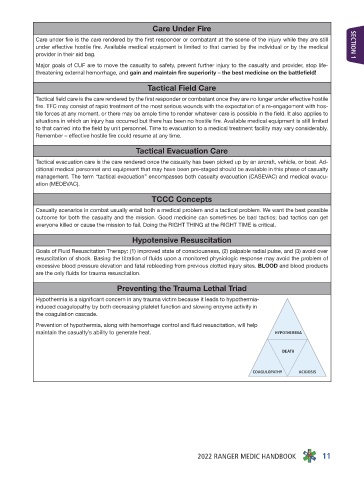
                          Preventing the Trauma Lethal Triad
         Hypothermia is a significant concern in any trauma victim because it leads to hypothermia-
         induced coagulopathy by both decreasing platelet function and slowing enzyme activity in
         the coagulation cascade.
         Prevention of hypothermia, along with hemorrhage control and fluid resuscitation, will help
         maintain the casualty’s ability to generate heat.   HYPOTHERMIA
                                                              DEATH

                                                        COAGULOPATHY  ACIDOSIS


                                            2022 RANGER MEDIC HANDBOOK  11

