


Page 235 - 2022 Ranger Medic Handbook
P. 235
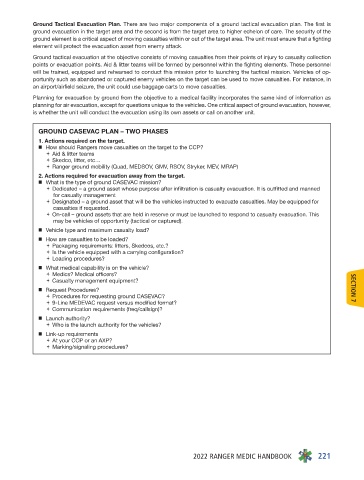
Ground Tactical Evacuation Plan. There are two major components of a ground tactical evacuation plan. The first is
        ground evacuation in the target area and the second is from the target area to higher echelon of care. The security of the
        ground element is a critical aspect of moving casualties within or out of the target area. The unit must ensure that a fighting
        element will protect the evacuation asset from enemy attack.
        Ground tactical evacuation at the objective consists of moving casualties from their points of injury to casualty collection
        points or evacuation points. Aid & litter teams will be formed by personnel within the fighting elements. These personnel
        will be trained, equipped and rehearsed to conduct this mission prior to launching the tactical mission. Vehicles of op-
        portunity such as abandoned or captured enemy vehicles on the target can be used to move casualties. For instance, in
        an airport/airfield seizure, the unit could use baggage carts to move casualties.
        Planning for evacuation by ground from the objective to a medical facility incorporates the same kind of information as
        planning for air evacuation, except for questions unique to the vehicles. One critical aspect of ground evacuation, however,
        is whether the unit will conduct the evacuation using its own assets or call on another unit.
         GROUND CASEVAC PLAN – TWO PHASES
         1. Actions required on the target.
         ■   How should Rangers move casualties on the target to the CCP?
           É   Aid & litter teams
           É   Skedco, litter, etc…
           É   Ranger ground mobility (Quad, MEDSOV, GMV, RSOV, Stryker, MEV, MRAP)
         2. Actions required for evacuation away from the target.
         ■   What is the type of ground CASEVAC mission?
           É   Dedicated – a ground asset whose purpose after infiltration is casualty evacuation. It is outfitted and manned
             for casualty management
           É   Designated – a ground asset that will be the vehicles instructed to evacuate casualties. May be equipped for
             casualties if requested.
           É   On-call – ground assets that are held in reserve or must be launched to respond to casualty evacuation. This
             may be vehicles of opportunity (tactical or captured).
         ■   Vehicle type and maximum casualty load?
         ■   How are casualties to be loaded?
           É   Packaging requirements: litters, Skedcos, etc.?
           É   Is the vehicle equipped with a carrying configuration?
           É   Loading procedures?
         ■   What medical capability is on the vehicle?
           É   Medics? Medical officers?
           É   Casualty management equipment?
         ■   Request Procedures?                                             SECTION 7
           É   Procedures for requesting ground CASEVAC?
           É   9-Line MEDEVAC request versus modified format?
           É   Communication requirements (freq/callsign)?
         ■   Launch authority?
           É   Who is the launch authority for the vehicles?
         ■   Link-up requirements
           É   At your CCP or an AXP?
           É   Marking/signaling procedures?


                                           2022 RANGER MEDIC HANDBOOK  221

