


Page 229 - 2022 Ranger Medic Handbook
P. 229
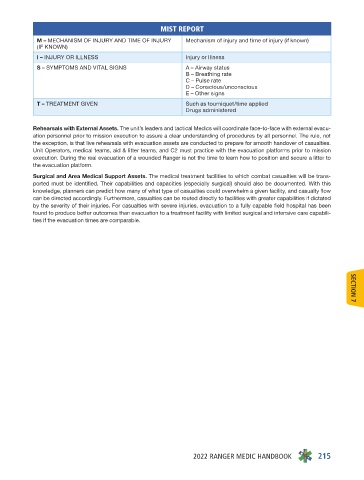
MIST REPORT
         M – MECHANISM OF INJURY AND TIME OF INJURY   Mechanism of injury and time of injury (if known)
         (IF KNOWN)
         I – INJURY OR ILLNESS           Injury or Illness
         S – SYMPTOMS AND VITAL SIGNS    A – Airway status
                                         B – Breathing rate
                                         C – Pulse rate
                                         D – Conscious/unconscious
                                         E – Other signs
         T – TREATMENT GIVEN             Such as tourniquet/time applied
                                         Drugs administered
        Rehearsals with External Assets. The unit’s leaders and tactical Medics will coordinate face-to-face with external evacu-
        ation personnel prior to mission execution to assure a clear understanding of procedures by all personnel. The rule, not
        the exception, is that live rehearsals with evacuation assets are conducted to prepare for smooth handover of casualties.
        Unit Operators, medical teams, aid & litter teams, and C2 must practice with the evacuation platforms prior to mission
        execution. During the real evacuation of a wounded Ranger is not the time to learn how to position and secure a litter to
        the evacuation platform.
        Surgical and Area Medical Support Assets. The medical treatment facilities to which combat casualties will be trans-
        ported must be identified. Their capabilities and capacities (especially surgical) should also be documented. With this
        knowledge, planners can predict how many of what type of casualties could overwhelm a given facility, and casualty flow
        can be directed accordingly. Furthermore, casualties can be routed directly to facilities with greater capabilities if dictated
        by the severity of their injuries. For casualties with severe injuries, evacuation to a fully capable field hospital has been
        found to produce better outcomes than evacuation to a treatment facility with limited surgical and intensive care capabili-
        ties if the evacuation times are comparable.                         SECTION 7


                                           2022 RANGER MEDIC HANDBOOK  215

