


Page 19 - 2022 Ranger Medic Handbook
P. 19
SCOPE OF PRACTICE
        CASUALTY RESPONSE SYSTEM – The Regiment’s solution for managing combat casualties is to recognize that the
        problem is solved by the entire unit, not just medics, and that a casualty can occur during any phase of an operation.
        The principles of the casualty response system are the first responder to a casualty can be any Ranger in the unit; that   SECTION 1
        medical personnel manage casualty care; and that leaders run the mission. When a casualty is incurred, it immediately
        becomes a component of the unit’s mission to extract, treat, and evacuate the casualty while still completing the assigned
        combat mission as an integrated team. Thus, every member of the unit must maintain first responder medical skills, med-
        ics must be highly proficient, and leaders must know how to properly integrate casualty management into any phase of
        an operation.
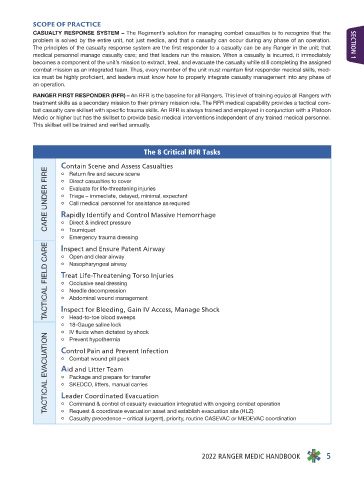
        RANGER FIRST RESPONDER (RFR) – An RFR is the baseline for all Rangers. This level of training equips all Rangers with
        treatment skills as a secondary mission to their primary mission role. The RFR medical capability provides a tactical com-
        bat casualty care skillset with specific trauma skills. An RFR is always trained and employed in conjunction with a Platoon
        Medic or higher but has the skillset to provide basic medical interventions independent of any trained medical personnel.
        This skillset will be trained and verified annually.

                                The 8 Critical RFR Tasks
              Contain Scene and Assess Casualties
           CARE UNDER FIRE  Rapidly Identify and Control Massive Hemorrhage
                Return fire and secure scene
                 °
                 °
                Direct casualties to cover
                 °
                Evaluate for life-threatening injuries
                 °
                Triage – immediate, delayed, minimal, expectant
                Call medical personnel for assistance as required
                 °
                Direct & indirect pressure
                 °
                Tourniquet
                 °
                 ° Inspect and Ensure Patent Airway                          SECTION 6
                Emergency trauma dressing
           TACTICAL FIELD CARE  Treat Life-Threatening Torso Injuries
                Open and clear airway
                 °
                 °
                Nasopharyngeal airway
                 °
                Occlusive seal dressing
                Needle decompression
                 °
                Abdominal wound management
                 °
                 °
                Head-to-toe blood sweeps
                 ° Inspect for Bleeding, Gain IV Access, Manage Shock
                18-Gauge saline lock
                IV fluids when dictated by shock
                 °
           TACTICAL EVACUATION  Control Pain and Prevent Infection
                Prevent hypothermia
                 °
                 °
                Combat wound pill pack
              Aid and Litter Team
                 °
                Package and prepare for transfer
                SKEDCO, litters, manual carries
                 °
              Leader Coordinated Evacuation
                Request & coordinate evacuation asset and establish evacuation site (HLZ)
                Casualty precedence – critical (urgent), priority, routine CASEVAC or  MEDEVAC coordination
                 °   °   °  Command & control of casualty evacuation integrated with ongoing combat operation
                                             2022 RANGER MEDIC HANDBOOK  5

