


Page 179 - 2022 Ranger Medic Handbook
P. 179
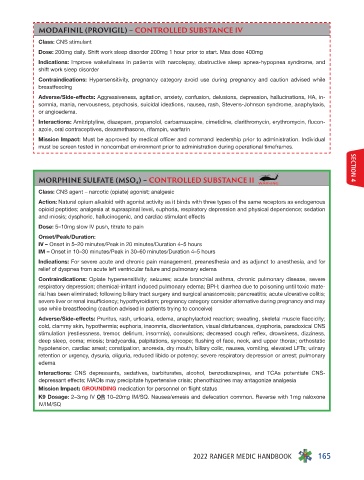
MODAFINIL (PROVIGIL) – CONTROLLED SUBSTANCE IV
         Class: CNS stimulant
         Dose: 200mg daily. Shift work sleep disorder 200mg 1 hour prior to start. Max dose 400mg
         Indications: Improve wakefulness in patients with narcolepsy, obstructive sleep apnea-hypopnea syndrome, and
         shift work sleep disorder
         Contraindications:  Hypersensitivity, pregnancy category avoid use during pregnancy and caution advised while
         breastfeeding
         Adverse/Side-effects: Aggressiveness, agitation, anxiety, confusion, delusions, depression, hallucinations, HA, in-
         somnia, mania, nervousness, psychosis, suicidal ideations, nausea, rash, Stevens-Johnson syndrome, anaphylaxis,
         or angioedema.
         Interactions: Amitriptyline, diazepam, propanolol, carbamazepine, cimetidine, clarithromycin, erythromycin, flucon-
         azole, oral contraceptives, dexamethasone, rifampin, warfarin
         Mission Impact: Must be approved by medical officer and command leadership prior to administration. Individual
         must be screen tested in noncombat environment prior to administration during operational timeframes.


         MORPHINE SULFATE (MSO 4 ) – CONTROLLED SUBSTANCE II                 SECTION 4
         Class: CNS agent – narcotic (opiate) agonist; analgesic
         Action: Natural opium alkaloid with agonist activity as it binds with three types of the same receptors as endogenous
         opioid peptides; analgesia at supraspinal level, euphoria, respiratory depression and physical dependence; sedation
         and miosis; dysphoric, hallucinogenic, and cardiac stimulant effects
         Dose: 5–10mg slow IV push, titrate to pain
         Onset/Peak/Duration:
         IV – Onset in 5–20 minutes/Peak in 20 minutes/Duration 4–5 hours
         IM – Onset in 10–30 minutes/Peak in 30–60 minutes/Duration 4–5 hours
         Indications: For severe acute and chronic pain management, preanesthesia and as adjunct to anesthesia, and for
         relief of dyspnea from acute left ventricular failure and pulmonary edema
         Contraindications:  Opiate hypersensitivity; seizures; acute bronchial asthma, chronic pulmonary disease, severe
         respiratory depression; chemical-irritant induced pulmonary edema; BPH; diarrhea due to poisoning until toxic mate-
         rial has been eliminated; following biliary tract surgery and surgical anastomosis; pancreatitis; acute ulcerative colitis;
         severe liver or renal insufficiency; hypothyroidism; pregnancy category consider alternative during pregnancy and may
         use while breastfeeding (caution advised in patients trying to conceive)
         Adverse/Side-effects: Pruritus, rash, urticaria, edema, anaphylactoid reaction; sweating, skeletal muscle flaccidity;
         cold, clammy skin, hypothermia; euphoria, insomnia, disorientation, visual disturbances, dysphoria, paradoxical CNS
         stimulation (restlessness, tremor, delirium, insomnia), convulsions; decreased cough reflex, drowsiness, dizziness,
         deep sleep, coma; miosis; bradycardia, palpitations, syncope; flushing of face, neck, and upper thorax; orthostatic
         hypotension, cardiac arrest; constipation, anorexia, dry mouth, biliary colic, nausea, vomiting, elevated LFTs; urinary
         retention or urgency, dysuria, oliguria, reduced libido or potency; severe respiratory depression or arrest; pulmonary
         edema
         Interactions:  CNS depressants, sedatives, barbiturates, alcohol, benzodiazepines, and TCAs potentiate CNS-
         depressant effects; MAOIs may precipitate hypertensive crisis; phenothiazines may antagonize analgesia
         Mission Impact: GROUNDING medication for personnel on flight status
         K9 Dosage: 2–3mg IV OR 10–20mg IM/SQ. Nausea/emesis and defecation common. Reverse with 1mg naloxone
         IV/IM/SQ


                                           2022 RANGER MEDIC HANDBOOK  165

