


Page 102 - JSOM Summer 2025
P. 102
Interview with Frank Butler


                                  By Maarten Leeflang MD, Former SOF medic trainer
                                          and Ryan Woets, Former SOF medic


                                                             CoTCCC Chair in addition to their assigned duties as the 1
                                                             Marine Expeditionary Force Surgeon. Both of these individu-
                                                             als are superb physicians and leaders, but they served in their
                                                             CoTCCC role as volunteers in addition to their assigned roles
                                                             in the Marine Corps. Each job inevitably takes time and atten-
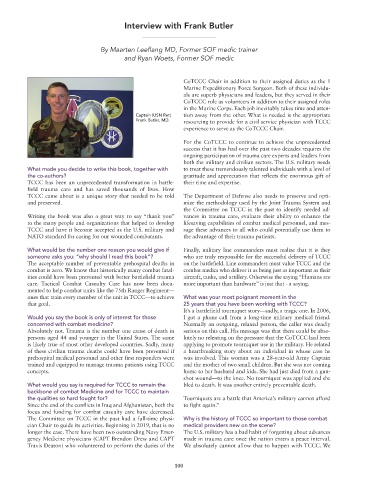
                                             Captain (USN Ret)   tion away from the other. What is needed is the appropriate
                                             Frank Butler, MD.  resourcing to provide for a civil service physician with TCCC
                                                             experience to serve as the CoTCCC Chair.
                                                             For  the  CoTCCC  to  continue  to  achieve  the  unprecedented
                                                             success that it has had over the past two decades requires the
                                                             ongoing participation of trauma care experts and leaders from
                                                             both the military and civilian sectors. The U.S. military needs
          What made you decide to write this book, together with   to treat these tremendously talented individuals with a level of
          the co-authors?                                    gratitude and appreciation that reflects the enormous gift of
          TCCC has been an unprecedented transformation in battle-  their time and expertise.
          field trauma care and has saved thousands of lives. How
          TCCC came about is a unique story that needed to be told   The Department of Defense also needs to preserve and opti-
          and preserved.                                     mize the methodology used by the Joint Trauma System and
                                                             the Committee on TCCC in the past to identify needed ad-
          Writing the book was also a great way to say “thank you”   vances in trauma care, evaluate their ability to enhance the
          to the many people and organizations that helped to develop   lifesaving capabilities of combat medical personnel, and mes-
          TCCC and have it become accepted as the U.S. military and   sage these advances to all who could potentially use them to
          NATO standard for caring for our wounded combatants.  the advantage of their trauma patients.
          What would be the number one reason you would give if   Finally,  military line  commanders must  realize  that it  is  they
          someone asks you: “why should I read this book”?   who are truly responsible for the successful delivery of TCCC
          The acceptable number of preventable prehospital deaths in   on the battlefield. Line commanders must value TCCC and the
          combat is zero. We know that historically many combat fatal-  combat medics who deliver it as being just as important as their
          ities could have been prevented with better battlefield trauma   aircraft, tanks, and artillery. Otherwise the saying “Humans are
          care.  Tactical Combat Casualty Care has now been docu-  more important than hardware” is just that - a saying.
          mented to help combat units like the 75th Ranger Regiment—
          ones that train every member of the unit in TCCC—to achieve   What was your most poignant moment in the
          that goal.                                         25 years that you have been working with TCCC?
                                                             It’s a battlefield tourniquet story—sadly, a tragic one. In 2006,
          Would you say the book is only of interest for those   I got a phone call from a long-time military medical friend.
          concerned with combat medicine?                    Normally an outgoing, relaxed person, the caller was deadly
          Absolutely not. Trauma is the number one cause of death in   serious on this call. His message was that there could be abso-
          persons aged 44 and younger in the United States. The same   lutely no relenting on the pressure that the CoTCCC had been
          is likely true of most other developed countries. Sadly, many   applying to promote tourniquet use in the military. He related
          of these civilian trauma deaths could have been prevented if   a heartbreaking story about an individual in whose case he
          prehospital medical personnel and other first responders were   was involved. This woman was a 28-year-old Army Captain
          trained and equipped to manage trauma patients using TCCC   and the mother of two small children. But she was not coming
          concepts.                                          home to her husband and kids. She had just died from a gun-
                                                             shot wound—to the knee. No tourniquet was applied and she
          What would you say is required for TCCC to remain the   bled to death. It was another entirely preventable death.
          backbone of combat Medicine and for TCCC to maintain
          the qualities so hard fought for?                  Tourniquets are a battle that America’s military cannot afford
          Since the end of the conflicts in Iraq and Afghanistan, both the   to fight again.”
          focus and funding for combat casualty care have decreased.
          The Committee on TCCC in the past had a full-time physi-  Why is the history of TCCC so important to those combat
          cian Chair to guide its activities. Beginning in 2019, that is no   medical providers new on the scene?
          longer the case. There have been two outstanding Navy Emer-  The U.S. military has a bad habit of forgetting about advances
          gency Medicine physicians (CAPT Brendon Drew and CAPT   made in trauma care once the nation enters a peace interval.
          Travis Deaton) who volunteered to perform the duties of the   We absolutely cannot allow that to happen with TCCC. We


                                                          100

