


Page 68 - JSOM Spring 2025
P. 68
managing TCA at forward surgical stabilization sites as a pre-  as an adjunct to CPR. The resuscitation was successful, and
          cursor and adjunct to DCS.                         the patient had ROSC en route to Role 2.
                                                             At the Role 2a stage, the patient also received a thoracotomy
          Methods
                                                             due to injuries to his lung (Figure 2). He was stabilized and
          The Ukrainian Medical Command approved this observa-  received two units of freeze-dried plasma transfused.  The
          tional study and the reporting of collected data. Four patients   AAJT-S stayed in place and inflated for 100 minutes.  The
          presented in severe hypovolemic shock from combat-related   AAJT-S was removed at the Role 2b stage, DCS was per-
          injuries during fighting in Bakhmut, Ukraine, in June 2022,   formed, internal bleeding was stopped, and component blood
          and two patients from fighting in Slovyansk in May 2023.   products were transfused.
          During casualty care, each went into TCA from hemorrhagic
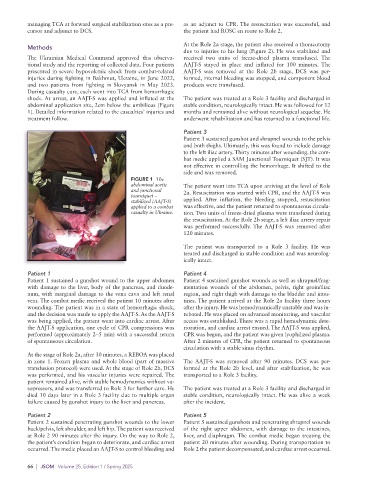
          shock. At arrest, an AAJT-S was applied and inflated at the   The patient was treated at a Role 3 facility and discharged in
          abdominal application site, 2cm below the umbilicus (Figure   stable condition, neurologically intact. He was followed for 12
          1). Detailed information related to the casualties’ injuries and   months and remained alive without neurological sequelae. He
          treatment follow.                                  underwent rehabilitation and has returned to a functional life.
                                                             Patient 3
                                                             Patient 3 sustained gunshot and shrapnel wounds to the pelvis
                                                             and both thighs. Ultimately, this was found to include damage
                                                             to the left iliac artery. Thirty minutes after wounding, the com-
                                                             bat medic applied a SAM Junctional Tourniquet (SJT). It was
                                                             not effective in controlling the hemorrhage. It shifted to the
                                                             side and was removed.
                                            FIGURE 1  The
                                            abdominal aortic   The patient went into TCA upon arriving at the level of Role
                                            and junctional   2a. Resuscitation was started with CPR, and the AAJT-S was
                                            tourniquet –
                                            stabilized (AAJT-S)   applied.  After inflation, the bleeding stopped, resuscitation
                                            applied to a combat   was effective, and the patient returned to spontaneous circula-
                                            casualty in Ukraine.  tion. Two units of freeze-dried plasma were transfused during
                                                             the resuscitation. At the Role 2b stage, a left iliac artery repair
                                                             was performed successfully. The AAJT-S was removed after
                                                             120 minutes.

                                                             The patient was transported to a Role 3 facility. He was
                                                             treated and discharged in stable condition and was neurolog-
                                                             ically intact.

          Patient 1                                          Patient 4
          Patient 1 sustained a gunshot wound to the upper abdomen   Patient 4 sustained gunshot wounds as well as shrapnel/frag-
          with damage to the liver, body of the pancreas, and duode-  mentation wounds of the abdomen, pelvis, right groin/iliac
          num, with marginal damage to the vena cava and left renal   region, and right thigh with damage to the bladder and intes-
          vein. The combat medic received the patient 10 minutes after   tines. The patient arrived at the Role 2a facility three hours
          wounding. The patient was in a state of hemorrhagic shock,   after the injury. He was hemodynamically unstable and was in-
          and the decision was made to apply the AAJT-S. As the AAJT-S   tubated. He was placed on advanced monitoring, and vascular
          was being applied, the patient went into cardiac arrest. After   access was established. There was a rapid hemodynamic dete-
          the AAJT-S application, one cycle of CPR compressions was   rioration, and cardiac arrest ensued. The AAJT-S was applied,
          performed (approximately 2–5 min) with a successful return   CPR was begun, and the patient was given lyophilized plasma.
          of spontaneous circulation.                        After 2 minutes of CPR, the patient returned to spontaneous
                                                             circulation with a stable sinus rhythm.
          At the stage of Role 2a, after 30 minutes, a REBOA was placed
          in zone 1. Frozen plasma and whole blood (part of massive   The  AAJT-S was removed after 90 minutes. DCS was per-
          transfusion protocol) were used. At the stage of Role 2b, DCS   formed at  the Role 2b level,  and after stabilization, he  was
          was performed, and his vascular injuries were repaired. The   transported to a Role 3 facility.
          patient remained alive, with stable hemodynamics without va-
          sopressors, and was transferred to Role 3 for further care. He   The patient was treated at a Role 3 facility and discharged in
          died 10 days later in a Role 3 facility due to multiple organ   stable condition, neurologically intact. He was alive a week
          failure caused by gunshot injury to the liver and pancreas.  after the incident.

          Patient 2                                          Patient 5
          Patient 2 sustained penetrating gunshot wounds to the lower   Patient 5 sustained gunshots and penetrating shrapnel wounds
          back/pelvis, left shoulder, and left hip. The patient was received   of the right upper abdomen, with damage to the intestines,
          at Role 2 90 minutes after the injury. On the way to Role 2,   liver, and diaphragm. The combat medic began treating the
          the patient’s condition began to deteriorate, and cardiac arrest   patient 20 minutes after wounding. During transportation to
          occurred. The medic placed an AAJT-S to control bleeding and   Role 2 the patient decompensated, and cardiac arrest occurred.

          66  |  JSOM   Volume 25, Edition 1 / Spring 2025

