


Page 9 - JSOM Spring 2023
P. 9
Combat Casualties Treated With Intranasal Ketamine for Pre-  INJURY PREVENTION
              hospital Analgesia: A Case Series: Optimal pain management   Association of Body Mass Index with Injuries: A Systematic
              is challenging in Tactical Combat Casualty Care (TCCC), par-  Review and Meta-Analyses Comparing Healthy Weight Mil-
              ticularly in remote and austere settings.          itary Service Members with Underweight, Overweight, and
                                                                 Obese: This article reports on a systematic review and me-
                                                                 ta-analysis examining the association between BMI and injury
                                                                 risk among military Servicemembers.

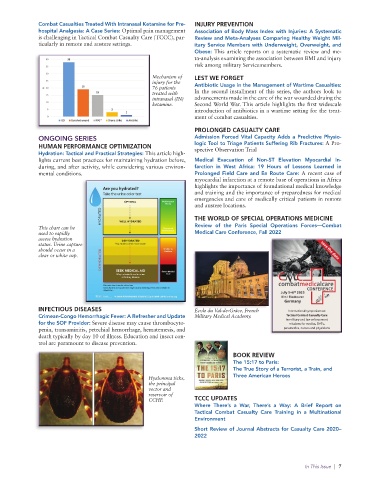
                                                   Mechanism of   LEST WE FORGET
                                                   injury for the   Antibiotic Usage in the Management of Wartime Casualties:
                                                   76 patients
                                                   treated with   In the second installment of this series, the authors look to
                                                   intranasal (IN)   advancements made in the care of the war wounded druing the
                                                   ketamine.     Second World War. This article highlights the first widescale
                                                                 introduction of antibiotics in a wartime setting for the treat-
                                                                 ment of combat casualties.

                                                                 PROLONGED CASUALTY CARE
              ONGOING SERIES                                     Admission Forced Vital Capacity Adds a Predictive Physio-
              HUMAN PERFORMANCE OPTIMIZATION                     logic Tool to Triage Patients Suffering Rib Fractures: A Pro-
                                                                 spective Observation Trial
              Hydration: Tactical and Practical Strategies: This article high-
              lights current best practices for maintaining hydration before,   Medical Evacuation of Non-ST Elevation Myocardial In-
              during, and after activity, while considering various environ-  farction in West Africa: 19 Hours of Lessons Learned in
              mental conditions.                                 Prolonged Field Care and En Route Care: A recent case of
                                                                 myocardial infarction at a remote base of operations in Africa
                                                                 highlights the importance of foundational medical knowledge
                                                                 and training and the importance of preparedness for medical
                                                                 emergencies and care of medically critical patients in remote
                                                                 and austere locations.

                                                                 THE WORLD OF SPECIAL OPERATIONS MEDICINE
                                                                 Review of the Paris Special Operations Forces—Combat
              This chart can be
              used to rapidly                                    Medical Care Conference, Fall 2022
              assess hydration
              status. Urine capture
              should occur in a
              clear or white cup.


              INFECTIOUS DISEASES                                École du Val-de-Grâce, French
              Crimean-Congo Hemorrhagic Fever: A Refresher and Update   Military Medical Academy.
              for the SOF Provider: Severe disease may cause thrombocyto-
              penia, transaminitis, petechial hemorrhage, hematemesis, and
              death typically by day 10 of illness. Education and insect con-
              trol are paramount to disease prevention.

                                                                             BOOK REVIEW
                                                                             The 15:17 to Paris:
                                                                             The True Story of a Terrorist, a Train, and
                                                                             Three American Heroes
                                                  Hyalomma ticks,
                                                  the principal
                                                  vector and
                                                  reservoir of
                                                  CCHF.          TCCC UPDATES
                                                                 Where There’s a War, There’s a Way: A Brief Report on
                                                                 Tactical Combat Casualty Care Training in a Multinational
                                                                 Environment
                                                                 Short Review of Journal Abstracts for Casualty Care 2020–
                                                                 2022


                                                                                                     In This Issue  |  7

