


Page 139 - JSOM Winter 2022
P. 139
project influence and security across the region. Together, these   US MILITARY ACCLIMATES UNITS
              pillars guide the United States’ affirmative agenda in the Arctic
              region for the next decade.”                       TO HIGH-ALTITUDE OPERATIONS
                                                                 Claudia Sanchez-Bustamante, MHS Communications, reports
              The topics presented are Executive Summary, Introduction: Our   “High altitude—generally considered at about 8,000 feet or
              Vision for the Arctic, Changing Conditions in the Arctic, Our   more above sea level—can negatively affect service members’
              Approach: Strategic Pillars and Guiding Principles, Pillar 1—  health as well as their physical and mental performance, espe-
              Security:  Develop  Capabilities  for  Expanded  Arctic  Activity,   cially if they’re not properly acclimated to it.
              Pillar 2—Climate Change and Environmental Protection: Build
              Resilience and Advance  Adaptation, while Mitigating Emis-  The lower pressure in that environment means there’s de-
              sions, Pillar 3—Sustainable Economic Development: Improve   creased availability of oxygen in the air around you, which
              Livelihoods and Expand Economic Opportunity, Pillar 4—In-  lowers the oxygen supply to your body. It can cause altitude
              ternational Cooperation and Governance: Sustain Arctic Insti-  illness within hours after arriving at high altitudes as your
              tutions and Uphold International Law, and The Way Forward.  body tries to adjust and you may require oxygen and medica-
                                                                 tion to feel better.
              The full report is given at  https://www.whitehouse.gov/wp-
              content/uploads/2022/10/National-Strategy-for-the-Arctic-   Yet even operating in locations above 4,000 feet above sea level
              Region.pdf                                         can cause acute mountain sickness, the most common and mild
                                                                 form of altitude illness, and decreased performance. Symptoms
              SHELF STABLE BLOOD PRODUCTS                        can include head and muscle aches, shortness of breath, dizzi-
                                                                 ness, and nausea, and may take between 1-3 days to subside.
              The abstract “Evaluation of Shelf Stable Blood Products for
              Resuscitation in a Canine Model of Hemorrhagic Shock” will   Training and acclimating your body to operate optimally at
              be presented at the Society of Critical Care Medicine’s 2023   altitudes higher than what you’re used to is key.
              Critical Care Congress in January 2023. The SOCOM-funded   Operating at high-altitude environments “is inherently hazard-
              study spearheaded by Institute for Surgical Research (ISR) and   ous,” said US Air Force Maj Elliott Reed, chief of the physio-
              carried out in collaboration with the University of Utah ex-  logical training branch at the Air Force Research Laboratory’s
              amined whether shelf-stable blood product resuscitation strat-  711th  Human  Performance  Wing,  at  Wright-Patterson  Air
              egies using freeze-dried plasma, a hemoglobin-based oxygen   Force Base near Dayton, Ohio.
              carrier, and lyophilized platelets can provide an alternative to
              conventional  hemorrhage resuscitation strategies  in canines.   “The Air Force takes a holistic approach to high-altitude oper-
              ORISE Fellow Dr Tom   Edwards and LTC Emilee Venn are   ations, ensuring operational success by focusing on personnel
              co-authors on the University of Utah abstract describing com-  selection, training, and equipment,” he added. “This is similar
              parison of thromboelastography (TEG 500) values between   to fire fighters, who are not conditioned to work in fires but
              resuscitation strategies.                          are instead prepared to mitigate the risk.”
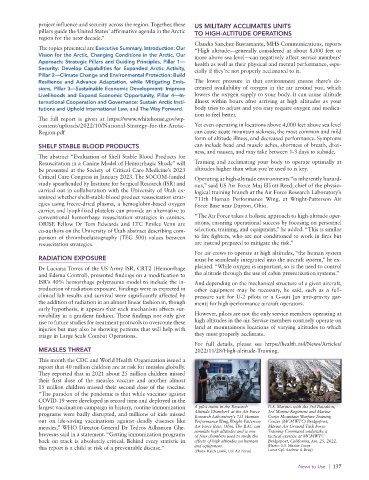
                                                                 For air crews to operate at high altitudes, “the human system
              RADIATION EXPOSURE                                 must be seamlessly integrated into the aircraft system,” he ex-
              Dr Luciana Torres of the US Army ISR, CRT2 (Hemorrhage   plained. “While oxygen is important, so is the need to control
              and Edema Control), presented findings on a modification to   the altitude through the use of cabin pressurization systems.”
              ISR’s 40% hemorrhage polytrauma model to include the in-  And depending on the mechanical structure of a given aircraft,
              troduction of radiation exposure. Findings were as expected in   other equipment may be necessary, he said, such as a full-
              clinical lab results and survival were significantly affected by   pressure suit for U-2 pilots or a G-suit [an anti-gravity gar-
              the addition of radiation in an almost linear fashion in, though   ment] for high-performance aircraft operators.
              early hypothesis, it appears that each mechanism affects sur-
              vivability in a gradient fashion. These findings not only give   However, pilots are not the only service members operating at
              rise to future studies for treatment protocols to overcome these   high altitudes in the air. Service members routinely operate on
              injuries but may also be showing patterns that will help with   land at mountainous locations of varying altitudes to which
              triage in Large Scale Combat Operations.           they must properly acclimate.
                                                                 For full details, please see  https://health.mil/News/Articles/
              MEASLES THREAT                                     2022/11/28/High-altitude-Training.
              This month the CDC and World Health Organization issued a
              report that 40 million children are at risk for measles globally.
              They reported that in 2021 about 25 million children missed
              their first dose of the measles vaccine and another almost
              15 million children missed their second dose of the vaccine.
              “The paradox of the pandemic is that while vaccines against
              COVID-19 were developed in record time and deployed in the
              largest vaccination campaign in history, routine immunization   A pilot trains in the Research   U.S. Marines with the 3rd Battalion,
              programs were badly disrupted, and millions of kids missed   Altitude Chamber1 at the Air Force   3rd Marine Regiment and Marine
                                                                                         Corps Mountain Warfare Training
                                                                 Research Laboratory’s 711 Human
              out on life-saving vaccinations against deadly diseases like   Performance Wing,Wright-Patterson     Center (MCMWTC) Bridgeport,
              measles,” WHO Director-General Dr Tedros Adhanom Ghe-  Air Force Base, Ohio. The RAC can     Marine Air Ground Task Force
              breyesus said in a statement. “Getting immunization programs   simulate high altitudes and is one     Training Command undertake a
                                                                                           tactical exercise at MCMWTC
                                                                 of four chambers used to study the
              back on track is absolutely critical. Behind every statistic in   effects of high altitudes on humans     Bridgeport, California, Jan. 25, 2022.
              this report is a child at risk of a preventable disease.”  and equipment.   (Photo: U.S. Marine Corps
                                                                 (Photo: Keith Lewis, U.S. Air Force)  Lance Cpl. Andrew R. Bray)
                                                                                                  News to Use  |  137

