


Page 23 - JSOM Summer 2022
P. 23
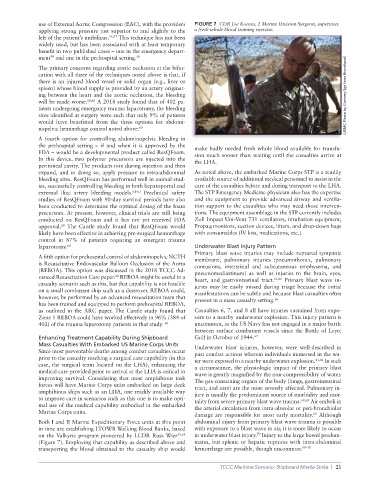
use of External Aortic Compression (EAC), with the providers   FIGURE 7  CDR Joe Kotora, 2 Marine Division Surgeon, supervises
              applying strong pressure just superior to and slightly to the   a fresh whole blood training exercise.
              left of the patient’s umbilicus. 56,57  This technique has not been
              widely used, but has been associated with at least temporary
              benefit in two published cases – one in the emergency depart-
                 59
              ment  and one in the prehospital setting. 58
              The primary concerns regarding aortic occlusion at the bifur-
              cation with all three of the techniques noted above is that, if
              there is an injured blood vessel or solid organ (e.g., liver or
              spleen) whose blood supply is provided by an artery originat-
              ing between the heart and the aortic occlusion, the bleeding                                        (USMC Photo by Gunnery Sgt Leon Branchaud)
              will be made worse. 28,60  A 2018 study found that of 402 pa-
              tients undergoing emergency trauma laparotomy, the bleeding
              sites identified at surgery were such that only 9% of patients
              would have benefitted from the three options for abdomi-
              nopelvic hemorrhage control noted above. 60
              A fourth option for controlling abdominopelvic bleeding in
              the prehospital setting – if and when it is approved by the    make badly needed fresh whole blood available for transfu-
              FDA – would be a developmental product called ResQFoam.   sion much sooner than waiting until the casualties arrive at
              In this device, two polymer precursors are injected into the   the LHA.
              peritoneal cavity. The products mix during injection and then
              expand, and in doing so, apply pressure to intra-abdominal   As noted above, the embarked Marine Corps STP is a readily
              bleeding sites. ResQFoam has performed well in animal stud-  available source of additional medical personnel to assist in the
              ies, successfully controlling bleeding in both hepatoportal and   care of the casualties before and during transport to the LHA.
              external iliac artery bleeding models. 61-63   Preclinical safety   The STP Emergency Medicine physician also has the expertise
              studies of  ResQFoam with 90-day survival periods have also   and the equipment to provide advanced airway and ventila-
              been conducted to determine the optimal dosing of the foam   tion support to the casualties who may need those interven-
              precursors. At present, however, clinical trials are still being   tions. The equipment assemblage in the STP currently includes
              conducted on ResQFoam and it has not yet received FDA   Zoll Impact Uni-Vent 731 ventilators, intubation equipment,
                     28
              approval.   The Cantle study found that  ResQFoam would   Propaq monitors, suction devices, litters, and drop-down bags
              likely have been effective in achieving pre-surgical hemorrhage   with consumables (IV kits, medications, etc.).
              control in 87% of patients  requiring an emergent trauma
              laparotomy. 60                                     Underwater Blast Injury Pattern
                                                                 Primary blast wave injuries may include ruptured tympanic
              A fifth option for prehospital control of abdominopelvic NCTH   membrane, pulmonary injuries (pneumothorax, pulmonary
              is Resuscitative Endovascular Balloon Occlusion of the Aorta   contusions, interstitial and subcutaneous emphysema, and
              (REBOA). This option was discussed in the 2018 TCCC Ad-  pneumomediastinum) as well as injuries to the brain, eyes,
              vanced Resuscitation Care paper.  REBOA might be useful in a   heart, and gastrointestinal tract. 65,66   Primary blast wave in-
                                       28
              casualty scenario such as this, but that capability is not feasible   juries may be easily missed during triage because the initial
              on a small combatant ship such as a destroyer. REBOA could,   manifestations can be subtle and because blast casualties often
              however, be performed by an advanced resuscitation team that   present in a mass casualty setting. 66
              has been trained and equipped to perform prehospital REBOA,
              as outlined in the ARC paper. The Cantle study found that   Casualties 6, 7, and 8 all have injuries sustained from expo-
              Zone 1 REBOA could have worked effectively in 96% (384 of   sure to a nearby underwater explosion. This injury pattern is
              402) of the trauma laparotomy patients in that study.  60  uncommon, as the US Navy has not engaged in a major battle
                                                                 between surface combatant vessels since the Battle of Leyte
              Enhancing Treatment Capability During Shipboard    Gulf in October of 1944. 67
              Mass Casualties With Embarked US Marine Corps Units  Underwater blast injuries, however, were well-described in
              Since most preventable deaths among combat casualties occur   past combat actions wherein individuals immersed in the wa-
              prior to the casualty reaching a surgical care capability (in this   ter were exposed to a nearby underwater explosion. 41,42  In such
              case, the surgical team located on the LHA), enhancing the   a circumstance, the physiologic impact of the primary blast
              medical care provided prior to arrival at the LHA is critical to   wave is greatly magnified by the non-compressibility of water.
              improving survival. Considering that most amphibious task   The gas-containing organs of the body (lungs, gastrointestinal
              forces will have Marine Corps units embarked on large deck   tract, and ears) are the most severely affected. Pulmonary in-
              amphibious ships such as an LHA, one readily available way   jury is usually the predominant source of morbidity and mor-
              to improve care in scenarios such as this one is to make opti-  tality from severe primary blast wave trauma. 68,69  Air emboli in
              mal use of the medical capability embodied in the embarked   the arterial circulation from intra-alveolar or peri-bronchiolar
              Marine Corps units.
                                                                 damage are responsible for most early mortality.  Although
                                                                                                       69
              Both I and II Marine Expeditionary Force units at this point   abdominal injury from primary blast wave trauma is possible
              in time are establishing LTOWB Walking Blood Banks, based   with exposure to a blast wave in air, it is more likely to occur
                                                                                     70
              on the Valkyrie program pioneered by LCDR Russ Wier 35,64    in underwater blast injury.  Injury to the large bowel predom-
              (Figure 7). Employing that capability as described above and   inates, but splenic or hepatic ruptures with intra- abdominal
              transporting the blood obtained to the casualty ship would   hemorrhage are possible, though uncommon. 68–70

                                                                         TCCC Maritime Scenario: Shipboard Missile Strike  |  21

