


Page 132 - JSOM Summer 2022
P. 132
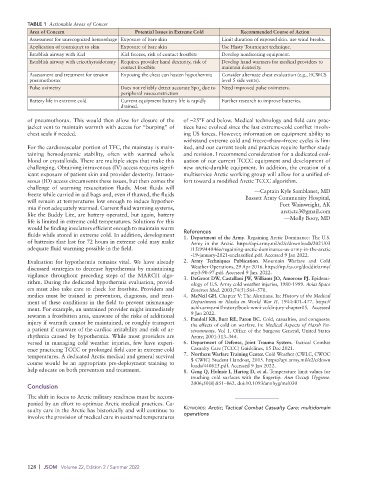
TABLE 1  Actionable Areas of Concer
           Area of Concern                   Potential Issues in Extreme Cold   Recommended Course of Action
           Assessment for unrecognized hemorrhage  Exposure of bare skin  Limit duration of exposed skin. use wind breaks.
           Application of tourniquet to skin  Exposure of bare skin      Use Hasty Tourniquet technique.
           Establish airway with iGel   iGel freezes, risk of contact frostbite   Develop nonfreezing equipment.
           Establish airway with cricothyroidotomy Requires provider hand dexterity, risk of   Develop hand warmers for medical providers to
                                        contact frostbite                maintain dexterity.
           Assessment and treatment for tension   Exposing the chest can hasten hypothermia   Consider alternate chest evaluation (e.g., ECWCS
           pneumothorax                                                  level 5 side vents).
           Pulse oximetry               Does not reliably detect accurate Spo  due to  Need improved pulse oximeters.
                                                                  2
                                        peripheral vasoconstriction
           Battery life in extreme cold   Current equipment battery life is rapidly   Further research to improve batteries.
                                        drained.

          of pneumothorax. This would then allow for closure of the   of –25°F and below. Medical technology and field care prac-
          jacket vent to maintain warmth with access for “burping” of   tices have evolved since the last extreme-cold conflict involv-
          chest seals if needed.                             ing US forces. However, information on equipment ability to
                                                             withstand extreme cold and freeze–thaw–freeze cycles is lim-
          For the cardiovascular portion of TFC, the mainstay is main-  ited, and our current tools and practices require further study
          taining hemodynamic stability, often with warmed whole   and revision. I recommend consideration for a dedicated eval-
          blood or crystalloids. There are multiple steps that make this   uation of our current TCCC equipment and development of
          challenging. Obtaining intravenous (IV) access requires signif-  new arctic-durable equipment. In addition, the creation of a
          icant exposure of patient skin and provider dexterity. Intraos-  multiservice Arctic working group will allow for a unified ef-
          seous (IO) access circumvents these issues, but then comes the   fort toward a modified Arctic TCCC algorithm.
          challenge of warming resuscitation fluids. Most fluids will               —Captain Kyle Samblanet, MD
          freeze while carried in aid bags and, even if thawed, the fluids       Bassett Army Community Hospital,
          will remain at temperatures low enough to induce hypother-                        Fort Wainwright, AK
          mia if not adequately warmed. Current fluid warming systems,                       arctictc3@gmail.com
          like the Buddy Lite, are battery operated, but again, battery                       — Molly Booy, MD
          life is limited in extreme cold temperatures. Solutions for this
          would be finding insulators efficient enough to maintain warm
          fluids while stored in extreme cold. In addition, development   References
                                                             1.  Department of the Army. Regaining Arctic Dominance: The U.S.
          of batteries that last for 72 hours in extreme cold may make   Army in the Arctic.  https://api.army.mil/e2/c/downloads/2021/03
          adequate fluid warming possible in the field.        /15/9944046e/regaining-arctic-dominance-us-army-in-the-arctic
                                                               -19-january-2021-unclassified.pdf. Accessed 9 Jan 2022.
          Evaluation for hypothermia remains vital. We have already   2.  Army Techniques Publication. Mountain Warfare and Cold
          discussed strategies to decrease hypothermia by maintaining   Weather Operations, 29 Apr 2016. https://irp.fas.org/doddir/army/
                                                               atp3-90-97.pdf. Accessed 9 Jan. 2022.
          vigilance throughout preceding steps of the MARCH algo-  3.  DeGroot DW, Castellani JW, Williams JO, Amoroso PJ. Epidemi-
          rithm. During the dedicated hypothermia evaluation, provid-  ology of U.S. Army cold weather injuries, 1980-1999. Aviat Space
          ers must also take care to check for frostbite. Providers and   Environ Med. 2003;74(5):564–570.
          medics must be trained in prevention, diagnosis, and treat-  4.  McNeil GH. Chapter V: The Aleutians. In: History of the Medical
          ment of these conditions in the field to prevent mismanage-  Department in Alaska in World War II. 1944:401–477.  https://
          ment. For example, an untrained provider might immediately   achh.army.mil/history/book-wwii-coldinjury-chapter05. Accessed
          rewarm a frostbitten area, unaware of the risks of additional   9 Jan 2022.
          injury if warmth cannot be maintained, or roughly transport   5.  Pandolf KB, Burr RE, Paton BC. Cold, casualties, and conquests:
                                                               the effects of cold on warfare. In: Medical Aspects of Harsh En-
          a patient if unaware of the cardiac irritability and risk of ar-  vironments. Vol 1. Office of the Surgeon General, United States
          rhythmia caused by hypothermia. While most providers are   Army; 2001:313–344.
          versed in managing cold weather injuries, few have experi-  6.  Department  of Defense,  Joint  Trauma System. Tactical Combat
          ence practicing TCCC or prolonged field care in extreme cold   Casualty Care (TCCC) Guidelines, 15 Dec 2021.
          temperatures. A dedicated Arctic medical and general survival   7.  Northern Warfare Training Center. Cold Weather (CWLC, CWOC
          course would be an appropriate pre-deployment training to   $ CWIC) Student Handout, 2015. https://api.army.mil/e2/c/down
                                                               loads/440625.pdf. Accessed 9 Jan 2022.
          help educate on both prevention and treatment.     8.  Geng Q, Holmér I, Hartog D, et al. Temperature limit values for
                                                               touching cold surfaces with the fingertip.  Ann Occup Hygiene.
                                                               2006;50(8):851–862. doi:10.1093/annhyg/mel030
          Conclusion
          The shift in focus to Arctic military readiness must be accom-
          panied by an effort to optimize Arctic medical practices. Ca-
          sualty care in the Arctic has historically and will continue to   Keywords: Arctic; Tactical Combat Casualty Care; multidomain
          involve the provision of medical care in sustained temperatures   operations


          128  |  JSOM   Volume 22, Edition 2 / Summer 2022

