


Page 126 - JSOM Summer 2022
P. 126
diagnostic resources, only 42% of pediatric sepsis patients   with the same temperature is more likely to show signs of
          meet the current criteria. When examining a sick child, ap-  fatigue or AMS. Additionally, the severity of fever does not
                                                                                                29
          pearance is often the first observation to give a “sick or not   necessarily correlate to the degree of illness.  A child with a
          sick”  impression.  Assessment  of  capillary refill  is  arguably   fever of 39.5°C (103.1°F) exhibiting an engaged affect is likely
          the most important preliminary finding  when examining   not as acutely ill as a child with a 37.9°C (100.2°F) fever who
          initial appearance, as delayed capillary refill is a significant   is somnolent and disengaged from their parents. Given these
          indicator that a patient is compensating poorly and requires   considerations, AMS in the presence of fever should prompt
          further assessment and intervention. 2,4,23–26  Delayed capillary   clinicians to expedite care.
          refill is directly associated with hemodynamic compensation
          in the septic patient and should guide treatment. Capillary   Further assessment of organ systems is needed to create a firm
          refill is associated with lactic acidosis, hypoxemia, decreased   differential diagnosis for sepsis in the absence of laboratory
          renal function, and cardiac output variability. When assessing   support. Renal dysfunction, respiratory dysfunction, and car-
          global skin presentation, pallor and mottling are commonly   diac dysfunction are all commonly observed in septic children.
          observed in later sepsis stages, whereas flushing occurs in ear-  Oliguria, especially with dark coloration, is a concerning find-
          lier stages. A sick child can present as pale or flushed during   ing which should create a high index of suspicion for the pres-
          initial assessment. However, cold and mottled skin indicates   ence of AKI. 20,22,27  Hypoxia, sustained tachypnea, retractions,
          an immediate need for intervention as mottling shows loss of   and accessory muscle use are all indicators of acute respiratory
          vascular tone and cardiac output simultaneously. 4, 23–26  In ad-  dysfunction. 2,27  Hypotension, delayed capillary refill, and sus-
          dition to skin appearance, a thorough head-to-toe inspection   tained tachycardia are indicators of cardiac dysfunction. 4,16,24,25
          of the skin’s surface should be performed. Open wounds are   The use of strong clinical assessment skills is paramount when
          regular sources of infection which lead to sepsis when left un-  in the austere environment, and clinicians should be compre-
          treated and may have gone unnoticed or poorly treated due   hensive with sick children due to the variety of ways they may
          to lack of resources.  1,3,27  If an object is found and suspected   compensate.
          to be causing the septic response, safely removing it is recom-
                 28
          mended.  Rashes, purpura, petechiae, sores, and edema are
          also essential findings indicative of an infection that will create   Vital Signs
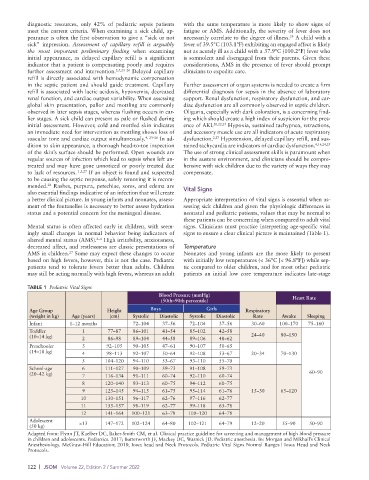
          a better clinical picture. In young infants and neonates, assess-  Appropriate interpretation of vital signs is essential when as-
          ment of the fontanelles is necessary to better assess hydration   sessing sick children and given the physiologic differences in
          status and a potential concern for the meningeal disease.  neonatal and pediatric patients, values that may be normal to
                                                             these patients can be concerning when compared to adult vital
          Mental status is often affected early in children, with seem-  signs. Clinicians must practice interpreting age-specific vital
          ingly small changes in normal behavior being indicators of   signs to ensure a clear clinical picture is maintained (Table 1).
                                 2–4
          altered mental status (AMS).  High irritability, anxiousness,
          decreased affect, and restlessness are classic presentations of   Temperature
                        27
          AMS in children.  Some may expect these changes to occur   Neonates and young infants are the more likely to present
          based on high fevers, however, this is not the case. Pediatric   with initially low temperatures (< 36°C [< 96.8°F]) while sep-
          patients tend to tolerate fevers better than adults. Children   tic compared to older children, and for most other pediatric
          may still be acting normally with high fevers, whereas an adult   patients  an initial  low core  temperature  indicates  late-stage

          TABLE 1  Pediatric Vital Signs
                                                     Blood Pressure (mmHg)
                                                      (50th–90th percentile)                     Heart Rate
           Age Group                Height        Boys              Girls        Respiratory
           (weight in kg)  Age (years)  (cm)  Systolic  Diastolic  Systolic  Diastolic  Rate  Awake  Sleeping
           Infant       1–12 months         72–104    37–56    72–104    37–56     30–60    100–170   75–160
           Toddler          1       77–87   86–101    41–54    85–102    42–58
           (10–14 kg)       2       86–98   89–104    44–58    89–106    48–62     24–40     80–150
           Preschooler      3       92–105  90–105    47–61    90–107    50–65
           (14–18 kg)       4       98–113  92–107    50–64    92–108    53–67     20–34     70–130
                            5      104–120  94–110    53–67    93–110    55–70
           School-age       6      111–127  90–109    59–73    91–108    59–73
           (20–42 kg)       7      116–134  91–111    60–74    92–110    60–74                        60–90
                            8      120–140  93–113    60–75    94–112    60–75
                            9      125–145  94–115    61–75    95–114    61–76     15–30     65–120
                           10      130–151  96–117    62–76    97–116    62–77
                           11      135–157  98–119    62–77    99–118    63–78
                           12      141–164  100–121   63–78    100–120   64–78
           Adolescent
           (50 kg)         >13     147–172  102–124   64–80    102–121   64–79     12–20     55–90    50–90
          Adapted from: Flynn JT, Kaelber DC, Baker-Smith CM, et al. Clinical practice guideline for screening and management of high blood pressure
          in children and adolescents. Pediatrics. 2017; Butterworth JF, Mackey DC, Wasnick JD. Pediatric anesthesia. In: Morgan and Mikhail’s Clinical
          Anesthesiology. McGraw-Hill Education; 2018; Iowa head and Neck Protocols. Pediatric Vital Signs Normal Ranges | Iowa Head and Neck
          Protocols.


          122  |  JSOM   Volume 22, Edition 2 / Summer 2022

