


Page 10 - JSOM Summer 2020
P. 10
THEN AND NOW – 20 YEARS IN                         clothing conditions (Bare, Scrubs, Uniform, Tights) mid-thigh
          PUBLICATION AND JSOM 20TH                          and on models (ballistic gel and yoga mats).
          ANNIVERSARY SPECIAL INTERVIEWS
                                                             Quality Assurance in Tactical Combat Casualty Care for
                                                             Medical Personnel Training April 2020:  A recent pilot ap-
                          We start the Fall Edition with our 20th-  praisal of four Tactical Combat Casualty Care for Medical
                            anniversary feature, Then and Now –  Personnel (TCCC-MP) training courses found that TCCC-MP
                             20 Years in Publication, focusing on  courses are not presenting all of the course material recom-
                              tourniquets and hemorrhage control.   mended by the Joint Trauma System (JTS), despite TCCC
                              We  list  the  many  articles  we  have   training having been mandated by the Department of Defense
                              published during the past 20 years,   (DoD) for all US military personnel.
                             with details  for those published
                            during the first 5 and the last 5 years.
                         The significance of the research reflected   In  Preparations for a Controversial Speaker and Antici-
                                                             pated Volatility in a College Town, the authors describe their
          in these articles is discussed in two editorials, “Tourniquets   successful experience when, in the summer of 2017, in Char-
          Last to Tourniquets First” and “Tourniquest.” You will enjoy   lottesville, Virginia, white nationalists clashed with counter-
          reading how this fundamental lifesaving device has evolved   protestors, ultimately leading to the death of three people and
          through the years. In addition, we have JSOM 20th Anniver-  leaving 34 more injured.
          sary Special Interview Podcasts with Dr John F. Kragh Jr, Dr
          Rich Lesperance, and CMSgt Michael Rubio.

          FEATURE ARTICLES
          The intent of Joint Trauma System Clinical Practice Guide-
          line: Austere Resuscitative and Surgical Care – 30 October
          2019 is to provide guidance for Austere Resuscitative and Sur-
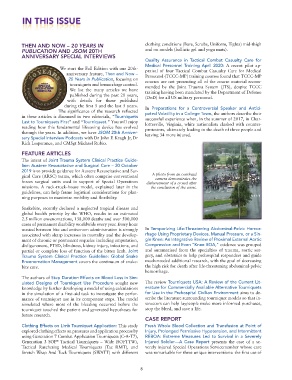
          gical Care (ARSC) teams, which often comprise conventional   A photo from an overhead
                                                                 camera demonstrates the
          forces surgical  units used in support of Special Operations   disbursement of a crowd after
          missions. A  ruck-truck-house model, explained later in the   the conclusion of the event.
          guidelines, can help frame logistical considerations for plan-
          ning purposes to maximize mobility and flexibility.

          Snakebite, recently declared a neglected tropical disease and
          global health priority by the WHO, results in an estimated
          2.5 million envenomations, 138,000 deaths and over 500,000
          cases of permanent disability worldwide every year. Every hour
          wasted between bite and antivenom administration is strongly   In Temporizing Life-Threatening Abdominal-Pelvic Hemor-
          associated with sharp increases in mortality and the develop-  rhage Using Proprietary Devices, Manual Pressure, or a Sin-
          ment of chronic or permanent sequelae including amputation,   gle Knee: An Integrative Review of Proximal External Aortic
          disfigurement, PTSD, blindness, kidney injury, infections, and   Compression and Even “Knee BOA,” evidence was grouped
          partial or complete loss of function of the bitten limb. Joint   and summarized from the specialties of trauma, aortic sur-
          Trauma System Clinical Practice Guideline: Global Snake   gery, and obstetrics to help prehospital responders and guide
          Envenomation Management covers the continuum of snake-  much-needed additional research, with the goal of decreasing
          bite care.                                         the high risk for death after life-threatening abdominal-pelvic
                                                             hemorrhage.
          The authors of Step Duration Effects on Blood Loss in Sim-
          ulated Designs of Tourniquet Use Procedure sought new   The review Tourniquets USA: A Review of the Current Lit-
          knowledge by further developing a model of using calculations   erature for Commercially Available Alternative Tourniquets
          in the simulation of a first-aid task to investigate the perfor-  for Use in the Prehospital Civilian Environment aims to de-
          mance of tourniquet use in its component steps. The model   scribe the literature surrounding tourniquet models so that in-
          simulated where most of the bleeding occurred before the   structors can help laypeople make more informed purchases,
          tourniquet touched the patient and generated hypotheses for   stop the bleed, and save a life.
          future research.
                                                             CASE REPORT
          Clothing Effects on Limb Tourniquet Application: This study   Fresh Whole Blood Collection and Transfusion at Point of
          explored clothing effects on pressures and application process by   Injury, Prolonged Permissive Hypotension, and Intermittent
          using Generation 7 Combat Application Tourniquets (C-A-T7),   REBOA: Extreme Measures Led to Survival in a Severely
                        ®
          Generation 3 SOF  Tactical Tourniquets – Wide (SOFTTW),   Injured Soldier—A Case Report  presents the case of a se-
          Tactical Ratcheting Medical Tourniquets (Tac RMT), and   verely injured Special Operations Servicemember whose care
          Stretch Wrap And Tuck Tourniquets (SWATT) with different   was remarkable for three unique interventions: the first use of


                                                           8

