


Page 160 - JSOM Spring 2020
P. 160
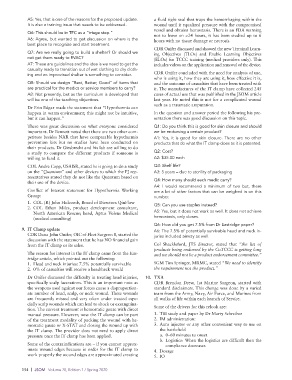
A5: Yes, that is one of the reasons for the proposed update.   a fluid tight seal that traps the hemorrhaging within the
            It is also a training issue that needs to be addressed.  wound until it equalized pressure with the compromised
                                                                 vessel and obtains hemostasis. There is an FDA warning
            Q6: This should be in TFC as a “triage step.”        not to leave on >24 hours, it has been studied up to 6
            A6: Agree, but wanted to get discussion on where is the   hours with no tissue damage or necrosis.
            best place to recognize and start treatment.
                                                                 CDR Onifer discussed and showed the new Terminal Learn-
            Q7: Are we really going to build a shelter? Or should we   ing Objectives (TLOs) and Enable Learning Objectives
            not get them ready to EVAC?                          (ELOs) for TCCC training (medical providers only). This
            A7: These are guidelines and the idea is we need to get the   includes videos on the application and removal of the device.
            casualty ready to transition out of wet clothing to dry cloth-
            ing and an improvised shelter is something to consider.  CDR Onifer concluded with the need for analysis of use,
                                                                 who is using it, how they are using it, how effective it is,
            Q8: Should we design “Best, Better, Good” of items that   and the outcome of casualties that have been treated with
            are practical for the medics or service members to carry?  it. The manufactures of the IT clamp have collected 245
            A8: Not presently, but as the curriculum is developed that   cases of actual use that was published in the JSOM article
            will be one of the teaching objectives.              last year. He noted this is not for a complicated wound
                                                                 such as a traumatic amputation.
            Dr Erin Edgar made the statement that “Hypothermia can
            happen in warm environment; this might not be intuitive,   In the question and answer period the following his pre-
            but it can happen.”                                  sentation there was good discussion on this topic.
            There was great discussion on what everyone considered   Q1: Do you think this is good for skin closure and should
            important. Dr Bennett noted that there are two other com-  we be endorsing a certain product?
            petitors besides NAR that have comparable hypothermia   A1: Yes, it is good for skin closure. There are no other
            prevention kits but no studies have been conducted on   products that do what the IT clamp does as it is patented.
            their products. Dr Giesbrecht and his lab are willing to do
            a study to compare the different products if someone is   Q2: Cost?
            willing to fund it.                                  A2: $35.00 each
            COL Andre Capp, USAISR, stated he is going to do a study   Q3: Shelf life?
            on the “Quantum” and other devices to which the PJ rep-  A3: 5 years – due to sterility of packaging
            resentatives stated they do not like the Quantum based on
            their use of the device.                             Q4: How many should each medic carry?
                                                                 A4: I would recommend a minimum of two but, there
            Conflict of Interest statement for Hypothermia Working   are a lot of other factors that can be weighed in on this
            Group:                                               number.
            1.  COL (R) John Holcomb, Board of Directors QinFlow  Q5: Can you use staples instead?
            2.  COL Ethan Miles, product development consultant,
               North  American  Rescue;  head,  Aptus  Volens Medical   A5: Yes, but it does not work as well. It does not achieve
               (medical consulting)                              hemostasis, only closes.
                                                                 Q6: How did you get 7.5% from Dr Eastridge paper?
          9.  IT Clamp update                                    A6: The 7.5% of potentially survivable head and neck in-
            CDR Dana John Onifer, OIC of Fleet Surgeon 8, started the   juries included airway as well.
            discussion with the statement that he has NO financial gain
            from the IT clamp or its sales.                      Col Shackleford, JTS director, stated  that  “the list  of
                                                                 products being endorsed by the CoTCCC is getting long
            The reason for interest in the IT clamp came from the Eas-  and we should not be a product endorsement committee.”
            tridge article, which pointed out the following:
            1.  Head and neck injuries: 7.5% potentially survivable  SGM Tim Springer, MRMC, stated “We need to identify
            2.  0% of casualties will receive a head/neck would  the requirement not the product.”
            Dr Onifer discussed the difficulty in treating head injuries,   10.  TXA
            specifically scalp lacerations. This is an important note as   CDR Brendon Drew, 1st Marine Surgeon, started with
            the weapons used against our forces cause a disproportion-  standard disclaimers. This change was done by a varied
            ate number of head, scalp, or neck wound. These wounds   team from the Army, Navy, Air Force, and Marines from
            are frequently missed and very often under treated espe-  all walks of life within each branch of Service.
            cially scalp wounds which can lead to shock or exsanguina-  Some of the drivers for this relook are:
            tion. The current treatment is hemostatic gauze with direct
            manual pressure. However, now the IT clamp can be part   1.  TBI study and paper by Dr Marty Schreiber
            of the treatment modality of packing the wound with he-  2.  IM administration:
            mostatic gauze or X-STAT and closing the wound up with   3.  Auto injector or any other convenient way to use on
            the IT clamp. The provider does not need to apply direct   the battlefield
            pressure once the IT clamp has been applied.           a.  0–60 minutes to onset
                                                                   b.  Logistics: When the logistics are difficult then the
            Some of the contraindications are – if you cannot approx-  compliance decreases
            imate wound edges because in order for the IT clamp to   4.  Dosage
            work properly the wound edges are approximated creating  5.  IO


          154  |  JSOM   Volume 20, Edition 1 / Spring 2020

