


Page 27 - JSOM Winter 2019
P. 27
(continued from page 7)

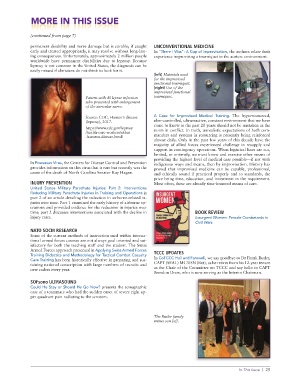
              permanent disability and nerve damage but is curable; if caught   UNCONVENTIONAL MEDICINE
              early and treated appropriately, it may resolve without long-last-  In “There I Was”: A Cup of Improvisation, the authors relate their
              ing consequences. Unfortunately, approximately 2 million people   experience improvising a tourniquet in the austere environment.
              worldwide have permanent disabilities due to leprosy. Because
              leprosy is not common in the United States, the diagnosis can be
              easily missed if clinicians do not think to look for it.
                                                                 (left) Materials used
                                                                 for the improvised
                                                                 junctional tourniquet.
                                                                 (right) Use of the
                                                                 improvised junctional
                                    Patient with M leprae infection   tourniquet.
                                    who presented with enlargement
                                    of the auricular nerve.

                                    Source: CDC, Hansen’s disease   A Case for Improvised Medical Training. The hyperresourced,
                                    (leprosy), 2017.             uber-controlled, ultrareactive, constant environment that we have
                                                                 come to know in the past 20 years should not be mistaken as the
                                    https://www.cdc.gov/leprosy   norm in conflict. In truth, unrealistic expectations of both com-
                                    /health-care-workers/other
                                    -hansens-disease.html/       manders and systems in resourcing is presently being reinforced
                                                                 almost daily. Only in the past few years of this decade have the
                                                                 majority of allied forces experienced challenge in resupply and
                                                                 support in contingency operations. When logistical lines are cut,
                                                                 limited, or untimely, we must know and exercise other means of
                                                                 providing the highest level of medical care possible—if not with
              In Powassan Virus, the Centers for Disease Control and Prevention   indigenous ways and means, then by improvisation. History has
              provides information on this virus that is rare but recently was the   proved that improvised medicine can be capable, professional,
              cause of the death of North Carolina Senator Kay Hagan.  and ethically sound if practiced properly and to standards, the
                                                                 price being time, education, and investment in the requirement.
              INJURY PREVENTION                                  Most often, these are already time-honored means of care.
              United States Military Parachute Injuries:  Part 2: Interventions
                Reducing Military Parachute Injuries in Training and Operations is
              part 2 of an article detailing the reduction in airborne-related in-
              juries over time. Part 1 examined the early history of airborne op-
              erations and provided evidence for the reduction in injuries over
              time; part 2 discusses interventions associated with the decline in   BOOK REVIEW
              injury rates.                                                       Insurgent Women: Female Combatants in
                                                                                  Civil Wars
              NATO SOCM RESEARCH
              Some of the current methods of instruction used within interna-
              tional armed forces courses are not always goal oriented and sat-
              isfactory for both the teaching staff and the student. The Swiss
              Armed Forces approach presented in Applying Swiss Armed Forces   TCCC UPDATES
              Training Didactics and Methodology for Tactical Combat Casualty
              Care Training has been historically effective in preparing and sus-  In CoTCCC Hail and Farewell, we say goodbye to Dr Frank Butler,
              taining national conscription with large numbers of recruits and   CAPT (SEAL) MC USN (Ret), as he retires from his 12-year tenure
              new cadres every year.                             as the Chair of the Committee on TCCC and say hello to CAPT
                                                                 Brendon Drew, who is now serving as the Interim Chairman.
              SOFsono ULTRASOUND
              Could He Stay or Should He Go Now? presents the sonographic
              case of a teammate who had the sudden onset of severe right up-
              per quadrant pain radiating to the scrotum.


                                                                 The Butler family
                                                                 minus son Jeff.


                                                                                                    In This Issue  |  25

