


Page 121 - JSOM Fall 2019
P. 121
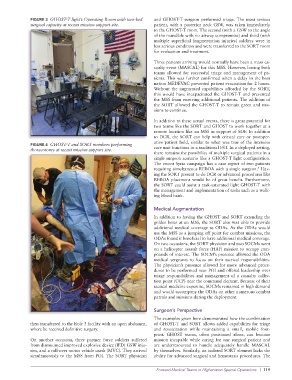
FIGURE 3  GHOST-T light’s Operating Room with two-bed   and  GHOST-T  surgeon  performed  triage.  The  most  serious
              surgical capacity at recent mission support site.  patient, with a posterior neck GSW, was taken immediately
                                                                 to the GHOST-T room. The second (with a GSW to the angle
                                                                 of the mandible with no airway compromise) and third (with
                                                                 multiple superficial fragmentation injuries) soldiers were in
                                                                 less serious condition and were transferred to the SORT room
                                                                 for evaluation and treatment.

                                                                 Three patients arriving would normally have been a mass ca-
                                                                 sualty event (MASCAL) for this MSS. However, having both
                                                                 teams allowed for successful triage and management of pa-
                                                                 tients. This was further confirmed when a delay in the host
                                                                 nation MEDEVAC prevented patient evacuation for 2 hours.
                                                                 Without the augmented capabilities afforded by the SORT,
                                                                 this would have incapacitated the GHOST-T and prevented
                                                                 the MSS from receiving additional patients. The addition of
                                                                 the SORT allowed the GHOST-T to remain green and mis-
                                                                 sions to continue.
                                                                 In addition to these actual events, there is great potential for
                                                                 two teams like the SORT and GHOST to work together at a
                                                                 remote location like an MSS in support of SOF. In addition
                                                                 to DCR, the SORT can help with critical care or postoper-
                                                                 ative patient hold, similar to what was true of the intensive
              FIGURE 4  GHOST-T and SORT members performing
              thoracotomy at recent mission support site.        care unit functions in a traditional FST. In a deployed setting,
                                                                 there remains the possibility of multiple surgical patients in a
                                                                 single surgeon scenario like a GHOST-T light configuration.
                                                                 The recent Syria campaign has a case report of two patients
                                                                 requiring simultaneous REBOA with a single surgeon.  Hav-
                                                                                                           9
                                                                 ing the SORT present to do DCR or advanced procedures like
                                                                 REBOA placement would be of great benefit. Furthermore,
                                                                 the SORT could assist a task-saturated light GHOST-T with
                                                                 the management and implementation of tasks such as a walk-
                                                                 ing blood bank.

                                                                 Medical Augmentation
                                                                 In addition to having the GHOST and SORT extending the
                                                                 golden hour at an MSS, the SORT also was able to provide
                                                                 additional medical coverage to ODAs. As the ODAs would
                                                                 use the MSS as a jumping off point for combat missions, the
                                                                 ODAs found it beneficial to have additional medical coverage.
                                                                 On two occasions, the SORT physician and two SOCMs went
                                                                 on a helicopter assault force (HAF) mission to occupy com-
                                                                 pounds of interest. The SOCM’s presence allowed the ODA
                                                                 medical sergeants to focus on their tactical responsibilities.
                                                                 The physician’s presence allowed for more advanced proce-
                                                                 dures to be performed near POI and offered leadership over
                                                                 triage responsibilities and management of a casualty collec-
                                                                 tion point (CCP) near the command element. Because of their
                                                                 tactical medicine expertise, SOCMs remained in high demand
                                                                 and would accompany the ODAs on other numerous combat
                                                                 patrols and missions during the deployment.

                                                                 Surgeon’s Perspective
                                                                 The examples given here demonstrated how the combination
              then transferred to the Role 3 facility with an open abdomen,   of GHOST-T and SORT allows added capabilities for triage
              where he received definitive surgery.              and resuscitation while maintaining a small, mobile foot-
                                                                 print. GHOST teams, often positioned alone, can become
              On another  occasion,  three partner  force  soldiers  suffered   mission incapable while caring for one surgical patient and
              from dismounted improved explosive device (IED) GSW inju-  are underresourced to handle adequately handle MASCAL
              ries, and a roll-over motor vehicle crash (MVC). They arrived   by themselves. Similarly, an isolated SORT element lacks the
              simultaneously  to the MSS from POI. The  SORT physician   ability for advanced surgical and hemostasis procedures. The

                                                                  Forward Medical Teams in Afghanistan Special Operations   |  119

