


Page 36 - JSOM Summer 2019
P. 36
Cypress Creek EMS Basic Tactical Operational
                                            Medical Support Course


                            Dan C. Godbee, MD, NREMT-P, COL, MC, FS, DMO, AL-ARNG


               he Cypress Creek EMS (CCEMS) Basic Tactical Opera-
               tional Medical Support (BTOMS) Course is an interna-
          Ttional, 80+-hour, 8-day total immersion course in tactical
          EMS. It is open to personnel with any medical background
          (EMT Basic and above) to educate, train, and prepare them to
          operate within a tactical law enforcement environment. This
          course provides certification in the NAEMT’s Tactical Combat
          Casualty Care (TCCC), as well as 91+ hours of CE/CHE credit
          in the three disciplines of EMS, fire, and law enforcement.

          The BTOMS Course is held twice a year and has drawn law en-
          forcement and medical professionals from around the country
          and the world, including Germany, Italy, Spain, England, Mex-
          ico, Brazil, New Zealand, Switzerland, Australia, and Canada.
          This course is the only Tactical EMS Training outside of Can-
          ada that is officially approved by the Canadian government.
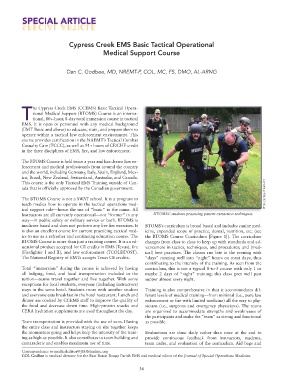
          The BTOMS Course is not a SWAT school. It is a program to                                            Photo courtesy of Norm Uhl.
          teach medics how to operate in the tactical operations med-
          ical support role—hence the use of “basic” in the name. All
          Instructors are all currently operational—not “former” in any   BTOMSC students practicing patient extraction techniques.
          way—in public safety or military service or both. BTOMS is
          medicine based and does not perform any live fire exercises. It   BTOMS’s curriculum is broad based and includes canine med-
          is also an excellent course for current practicing tactical med-  icine, expanded scope of practice, dental, nutrition, etc. (see
          ics to use as a refresher and continuing education course. The   the BTOMS Course Curriculum [Figure 1]). The curriculum
          BTOMS Course is more than just a training course. It is an ed-  changes from class to class to keep up with standards and ad-
          ucational product accepted for CE credits in EMS (Texas), fire   vancement in tactics, techniques, and procedures; and (med-
          (Firefighter I and II), and law enforcement (TCOLE/POST).   ical) best practices. The classes run late in the evening with
          The National Registry of EMTs accepts Texas CE credits.  “days” running well into “night” hours on most days, thus
                                                             contributing to the intensity of the training. As seen from the
          Total “immersion”  during the course  is achieved  by having   curriculum, this is not a typical 8-to-5 course with only 1 or
          all lodging, food, and local transportation included in the   maybe 2 days of “night” training; this class goes well past
          tuition—teams travel together and live together. With some   supper almost every night.
          exceptions for local students, everyone (including instructors)
          stays in the same hotel. Students room with another student   Training is also comprehensive in that it accommodates dif-
          and everyone eats breakfast in the hotel restaurant. Lunch and   ferent levels of medical training—from minimal (i.e., pure law
          dinner are cooked by CCEMS staff to improve the quality of   enforcement or fire with limited medicine) all the way to phy-
          the food and decrease down time. High-protein snacks and   sicians (i.e., surgeons and emergency physicians). The teams
          CERA hydration supplements are used throughout the day.  are organized to accommodate strengths and weaknesses of
                                                             the participants and make the “team” as strong and functional
          Team transportation is provided with the use of vans. Having   as possible.
          the entire class and instructors staying on site together keeps
          the momentum going and helps keep the intensity of the train-  Evaluations are  done daily rather  than once at  the end to
          ing as high as possible. It also contributes to team building and   provide continuous feedback from instructors, students,
          camaraderie and enables maximum use of time.       team cadre, and evaluation of the curriculum. Aid bags and
          Correspondence to medicaleditor@JSOMonline.org
          COL Godbee is medical director for the East Baton Rouge Parish EMS and medical editor of the Journal of Special Operations Medicine.

                                                           34

