


Page 29 - JSOM Summer 2019
P. 29
8.  Birmingham AR, Mah ND, Ran R, et al. Topical tranexamic   14.  Vu EN, Wan WCY, Yeung TC, et al. Intramuscular tran-
                 acid for the treatment of acute epistaxis in the emergency de-  examic acid in tactical and combat settings. J Spec Oper Med.
                 partment. Am J Emerg Med. 2018;36(7):1242–1245.    2018;18(1):62–68.
                9.  Tactical  Combat  Casualty  Care  Guidelines for  Medical    15.  McCormack, PL. Tranexamic acid: a review of its use in the
                 Personnel. 01 Aug 2018. https://www.naemt.org/docs/default   treatment of hyperfibrinolysis. Drugs. 2012;72(5):585–617.
                 -source/education-documents/tccc/tccc-mp/guidelines   16.  Wong J, Abrishami A, El Beheiry H, et al. Topical applica-
                 /tccc-guidelines-for-medical-personnel-180801.pdf?sfvrsn   tion of tranexamic acid reduces postoperative blood loss in
                 =13fc892_2                                         total knee arthroplasty: a randomized, controlled trial. J Bone
              10.  Shimonovich S, Gigi R, Shapira A, et al. Intranasal ketamine   Joint Surg Am. 2010;92(15):2503–2513.
                 for acute traumatic pain in the ED: a prospective, random-  17.  Connolly SJ, Milling TJ, Eikelboom JW, et al. ANNEXA-4.
                 ized  clinical trial of efficacy and  safety.  BMC  Emerg Med.   Andexanet alfa for acute major bleeding associated with fac-
                 2016;16(1):43.                                     tor Xa inhibitors. N Engl J Med. 2016;375(12):1131–41.
              11.  Cyklokapron (tranexamic acid) [package insert]. New York,   18.  Roberts I, Shakur H, Coats T, et al. The CRASH-2 trial: a
                 NY: Pfizer; Nov 2017. https://www.accessdata.fda.gov/drugs   randomized controlled trial and economic evaluation of the
                 atfda_docs/label/2017/019281s041lbl.pdf            effects of tranexamic acid on death, vascular occlusive events
              12.  Yukitatsu Y, Tsuzuki K, Takebayashi H, et al. Clinical study   and transfusion requirement in bleeding trauma patients.
                 of 1,515 patients presenting with epistaxis over the last 6   Health Technol Assess. 2013;17(10):1–79.
                 years. ORL. 2016;78(4):232–240.                 19.  Morrison JJ, Dubose JJ, Rasmussen TE, et al. Military Ap-
              13.  Schauer SG, April MD, Naylor JF, et al. Pre-hospital admin-  plication of Tranexamic Acid in Trauma Emergency Resusci-
                 istration of TXA by ground forces in afghanistan: the pre-   tation (MATTERs) study. Arch Surg. 2012;147(2):113–119.
                 hospital trauma registry experience. J Spec Oper Med. 2017;   20.  Montroy J, Hutton B, Moodley P, et al. The efficacy and
                 17(3):55–58.                                       safety of topical tranexamic acid: a systematic review and
                                                                      meta-analysis. Transfusion Med Rev. 2018;32:165–178.


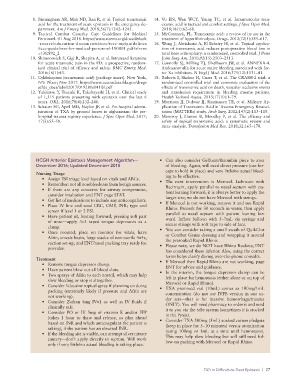
                HCGH Anterior Epistaxis Management Algorithm—      •  Can also consider Gelfoam/thrombin piece to area
                December 2016; Updated December 2018                 of bleeding. Again, will need direct pressure (use for-
                                                                     ceps to hold in place) and very little/no actual bleed-
                Nursing Triage
                  •  Assign ESI triage level based on vitals and ABCs.  ing to be effective.
                  •  Remember: not all nosebleeds are from benign sources.  •  The  next  intervention  is  Merocel.  Lubricate  with
                  •  If  there are  any concerns  for airway  compromise,   Bacitracin, apply parallel to nasal septum with pa-
                     consider intubation and ENT page STAT.          tient leaning forward; it is always better to apply the
                  •  Get list of medications to include any anticoagulants.  larger size; we do not have Merocel with strings.
                  •  Place IV line and send CBC, CMP, INR; type and   •  If Merocel is not working, remove it and use Rapid
                     screen if level 1 or 2 ESI.                     Rhino. Presoak for 30 seconds in water, then apply
                  •  Have patient sit, leaning forward, pressing soft part   parallel  to  nasal septum  with patient  leaning  for-
                     of nose—apply 3×3 taped tongue depressors as a   ward. Inflate balloon with 5–7mL via syringe and
                     clamp.                                          secure strings with soft tape to side of face.
                  •  Once roomed, place on monitor for vitals, have   •  You can consider taking a small swath of QuikClot
                       Afrin, emesis basin, large stacks of non-sterile 4×4s,   or Combat Gauze dressing and wrapping it around
                     suction set-up, and ENT/nasal packing tray ready for   the presoaked Rapid Rhino.
                     provider.                                     •  Please note, we do NOT have Rhino Rockets; ENT
                                                                     has considered these inferior. Also, using the correct
                                                                     terms helps clarify during over-the-phone consults.
                Treatment
                  •  Remove tongue depressor clamp.                •  If Merocel then Rapid Rhino are not working, page
                  •  Have patient blow out all blood clots.          ENT for advice and guidance.
                  •  Two sprays of Afrin to each nostril, which may help   •  In the interim, the tongue depressor clamp can be
                     slow bleeding or stop it altogether.            left in place for hemostasis (either alone or on top of
                  •  Consider lidocaine topical spray if planning on doing   Merocel or Rapid Rhino).
                     packing (extremely likely if pressure and Afrin are   •  TXA premixed vial (10mL) comes as 100mg/1mL
                     not working).                                   concentration (do not use IVPB version in our or-
                  •  Consider Zofran 4mg IV×1 as well as IV fluids if   der sets—that is for massive hemorrhage/trauma
                     clinically safe.                                ONLY). You will need pharmacy to order it and send
                  •  Consider PO or IV 5mg of vitamin K and/or FFP   it to you via the tube system (sometimes it is stocked
                     (takes 1 hour to thaw and release, so plan ahead   in the Pyxis).
                     based on INR and which anticoagulant the patient is   •  Consider TXA 500mg (5mL) soaked cotton pledgets
                     taking), if the patient has an elevated INR.    (keep in place for 5–10 minutes) versus atomization
                  •  If the bleeding site is visible, can attempt silver nitrate   (using 100mg or 1mL at a time until hemostasis).
                     cautery—don’t apply directly to septum. Will work   This may help slow bleeding but will still need fol-
                     only if very little/no actual bleeding is taking place.  low-on packing with Merocel or Rapid Rhino.


                                                                                     TXA in Difficult-to-Treat Epistaxis  |  27

