


Page 162 - JSOM Winter 2018
P. 162
Today it’s my honor to present that award to my friend and   videos have vastly improved the quality of the TCCC course
          colleague on the Committee on TCCC—Master Sergeant Har-  content,  both  through  standardizing  the  message  delivered
          old “Monty” Montgomery.                            and through making the educational content more visually en-
                                                             gaging to the student.
          Monty served in the 75th Ranger Regiment for 22 years and
          completed 12 full combat deployments to Iraq and Afghani-  Another aspect of the Deployed Medicine research effort that
          stan as well as numerous shorter missions and was part of the   Monty has guided has been to develop a TCCC application
          medical leadership team that made the 75th Ranger Regiment   that can be downloaded onto a medic’s smart phones. This is
          synonymous with excellence in TCCC.                very helpful when they are in areas in which internet service
                                                             is not available.
          After his time in the Ranger Regiment, MSG (Ret) Montgom-
          ery was selected to be the Senior Enlisted Medical Advisor for   Monty has revolutionized TCCC’s strategic messaging strat-
          the 70,000-person US Special Operations Command, a posi-  egy. He has correctly pointed out that if we want to more
          tion of great trust and respect. He is also the current President   effectively reach younger medics, we have to use Facebook,
          of the Special Operations Medical Association.     Twitter, Instagram, and other social media platforms—and he
                                                             has made that happen.
          MSG (Ret) Montgomery has been a member of the Committee
          on Tactical Combat Casualty Care for many years and is one   Lastly, Monty realized the need for a comprehensive but more
          of our hardest workers. Several years ago, he was honored   succinct TCCC reference document and went on to devel op the
          with the TCCC Award, which is given annually to the person   TCCC Quick Reference Guide. This document is an outstand-
          who has done the most to help advance TCCC. Now that he is   ing ed ucational adjunct for anyone trying to master TCCC
          out of the military, he is working full-time with the CoTCCC   concepts. The TCCC Quick Reference Guide also includes the
          and has continued to be a force of nature working on behalf   first-ever and very well-done TCCC Clinical Algorithms. And
          of combat medics, corpsmen, and PJs.               did I mention that it is free? You can download it without
                                                             charge from the Deployed Medicine, NAEMT, or other TCCC
          Monty authored one major TCCC change paper last year. He   hosting websites.
          is now the change leader for an update on which tourniquets
          will be recommended by TCCC. This matters to you as civilian   So if you are a military or a civilian medic and you get a tweet
          EMS providers because: (1) with Monty doing his usual su-  about a new TCCC recommendation, or you pull up your
          perb job, this will be one of the best and most comprehensive   TCCC Quick Reference Guide to walk through how to ad-
          papers on tourniquets in the literature; and (2) the American   dress a specific clinical scenario, or you go onto the Deployed
          College of Surgeons-sponsored Stop the Bleed training course   Medicine website to look up a TCCC teaching module, or you
          suggests that organizations buy tourniquets that are recom-  are looking at a high-quality video on how to perform a sur-
          mended by Committee on TCCC.                       gical airway during the TCCC for Medical Personnel course—
                                                             just think to yourself: “Thanks, Monty!”
          In the last 2 years, MSG (Ret) Montgomery has worked ex-
          tensively with the team from the Defense Health Agency   I certainly say that many times each week.
          Deployed Medicine research program and the University of
          Miami  Ryder  Trauma  Center  to  create  33  high-quality  vid-  Today I would like to say “Thanks, Monty” on behalf of the
          eos that have now been incorporated into the 2018 TCCC for   entire NAEMT organization as we present him with this year’s
          Medical Personnel Curriculum that came out in August. These   Scott Frame Service Award.


          Dr Frank Butler Receives NAEMT’s 2018
          Rocco V. Morando Lifetime Achievement Award
               aptain Frank K. Butler Jr (USN Ret), MD, was pre-
               sented with the 2018 Rocco V. Morando Lifetime
          CAchievement Award, recognizing a lifetime of commit-
          ment, contributions and leadership to emergency medical ser-
          vices (EMS). The award is NAEMT’s most prestigious and is
          generously sponsored by the National Registry of Emergency
          Medical Technicians (NREMT). The presentation was made
          during NAEMT’s annual General Membership Meeting in
          Nashville on October 30.

          Dr Butler has conducted, promoted, and applied the results
          of both Military Health System and civilian trauma research
          in his roles as the founder of Tactical Combat Casualty Care
          (TCCC) and – for the past decade – as the Chairman of the
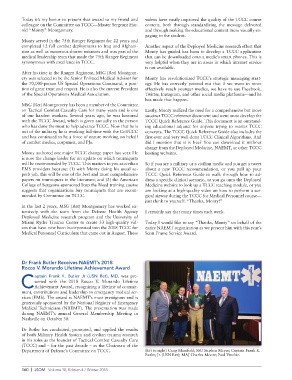
          Department of Defense’s Committee on TCCC.         (left to right) Craig Manifold; SSG Stephen Meyer; Captain Frank K.
                                                             Butler, Jr. (USN Ret); MAJ Charles Moore; Paul Vecchio


          160  |  JSOM   Volume 18, Edition 4 / Winter 2018

