


Page 156 - Journal of Special Operations Medicine - Fall 2017
P. 156
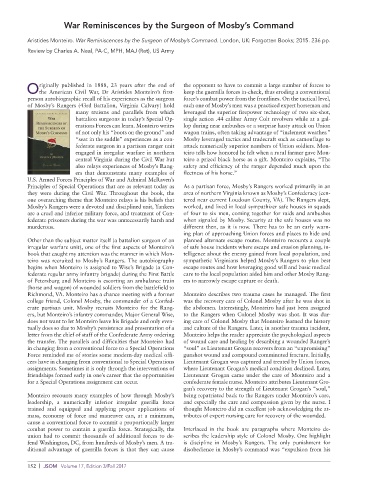
War Reminiscences by the Surgeon of Mosby’s Command


          Aristides Monteiro. War Reminiscences by the Surgeon of Mosby’s Command. London, UK: Forgotten Books; 2015. 236 pp.
          Review by Charles A. Neal, PA-C, MPH, MAJ (Ret), US Army


              riginally published in 1888, 23 years after the end of   the opponent to have to commit a large number of forces to
          Othe American Civil War, Dr Aristides Monteiro’s first-  keep the guerrilla forces in-check, thus eroding a conventional
          person autobiographic recall of his experiences as the surgeon   force’s combat power from the frontlines. On the tactical level,
          of Mosby’s Rangers (43rd Battalion, Virginia Calvary) hold   each one of Mosby’s men was a practiced expert horseman and
                          many truisms and parallels from which   leveraged the superior firepower technology of two six-shot,
                          battalion surgeons in today’s Special Op-  single action .44 caliber Army Colt revolvers while at a gal-
                          erations Forces can learn. Monteiro writes   lop during near ambushes or a surprise hasty attack on Union
                          of not only his “boots on the ground” and   wagon trains, often taking advantage of “inclement weather.”
                          “seat in the saddle” experiences as a con-  Mosby leveraged tactics and tradecraft such as camouflage to
                          federate surgeon in a partisan ranger unit   attack numerically superior numbers of Union soldiers. Mon-
                          engaged in irregular warfare in northern   teiro tells how honored he felt when a rural farmer gave Mon-
                          central Virginia during the Civil War but   teiro a prized black horse as a gift. Monteiro explains, “The
                          also relays experiences of Mosby’s Rang-  safety and efficiency of the ranger depended much upon the
                          ers that demonstrate many examples of   fleetness of his horse.”
          U.S. Armed Forces Principles of War and Admiral McRaven’s
          Principles of Special Operations that are as relevant today as   As a partisan force, Mosby’s Rangers worked primarily in an
          they were during the Civil War. Throughout the book, the   area of northern Virginia known as Mosby’s Confederacy (cen-
          one overarching theme that Monteiro relays is his beliefs that   tered near current Loudoun County, VA). The Rangers slept,
          Mosby’s Rangers were a devoted and disciplined unit, Yankees   worked, and lived in local sympathizer safe houses in squads
          are a cruel and inferior military force, and treatment of Con-  of four to six men, coming together for raids and ambushes
          federate prisoners during the war was unnecessarily harsh and   when signaled by Mosby. Security at the safe houses was no
          murderous.                                         different then, as it is now. There has to be an early warn-
                                                             ing plan of approaching Union forces and places to hide and
          Other than the subject matter itself (a battalion surgeon of an   planned alternate escape routes. Monteiro recounts a couple
          irregular warfare unit), one of the first aspects of Monteiro’s   of safe house incidents where escape and evasion planning, in-
          book that caught my attention was the manner in which Mon-  telligence about the enemy gained from local population, and
          teiro was recruited to Mosby’s Rangers. The autobiography   sympathetic Virginians helped Mosby’s Rangers to plan best
          begins when Monteiro is assigned to Wise’s Brigade (a Con-  escape routes and how leveraging good will and basic medical
          federate regular army infantry brigade) during the First Battle   care to the local population aided him and other Mosby Rang-
          of Petersburg and Monteiro is escorting an ambulance train   ers to narrowly escape capture or death.
          (horse and wagon) of wounded soldiers from the battlefield to
          Richmond, VA. Monteiro has a chance meeting with a former   Monteiro describes two trauma cases he managed. The first
          college friend, Colonel Mosby, the commander of a Confed-  was the recovery care of Colonel Mosby after he was shot in
          erate partisan unit. Mosby recruits Monteiro for the Rang-  the abdomen. Interestingly, Monteiro had just been assigned
          ers, but Monteiro’s infantry commander, Major General Wise,   to the Rangers when Colonel Mosby was shot. It was dur-
          does not want to let Monteiro leave his Brigade and only even-  ing care of Colonel Mosby that Monteiro learned the history
          tually does so due to Mosby’s persistence and presentation of a   and culture of the Rangers. Later, in another trauma incident,
          letter from the chief of staff of the Confederate Army ordering   Monteiro helps the reader appreciate the psychological aspects
          the transfer. The parallels and difficulties that Monteiro had   of wound care and healing by describing a wounded Ranger’s
          in changing from a conventional force to a Special Operations   “soul” as Lieutenant Grogan recovers from an “unpromising”
          Force reminded me of stories some modern-day medical offi-  gunshot wound and compound comminuted fracture. Initially,
          cers have in changing from conventional to Special Operations   Lieutenant Grogan was captured and treated by Union forces,
          assignments. Sometimes it is only through the interventions of   where Lieutenant Grogan’s medical condition declined. Later,
          friendships formed early in one’s career that the opportunities   Lieutenant Grogan came under the care of Monteiro and a
          for a Special Operations assignment can occur.     confederate female nurse. Monteiro attributes Lieutenant Gro-
                                                             gan’s recovery to the strength of Lieutenant Grogan’s “soul,”
          Monteiro recounts many examples of how through Mosby’s   being repatriated back to the Rangers under Monteiro’s care,
          leadership, a numerically inferior irregular guerilla force   and especially the care and compassion given by the nurse. I
          trained  and  equipped  and applying  proper  applications  of   thought Monteiro did an excellent job acknowledging the at-
          mass, economy of force and maneuver can, at a minimum,   tributes of expert nursing care for recovery of the wounded.
          cause a conventional force to commit a proportionally larger
          combat power to contain a guerilla force. Strategically, the   Interlaced in the book are paragraphs where Monteiro de-
          union had to commit thousands of additional forces to de-  scribes the leadership style of Colonel Mosby. One highlight
          fend Washington, DC, from hundreds of Mosby’s men. A tra-  is discipline in Mosby’s Rangers. The only punishment for
          ditional advantage of guerrilla forces is that they can cause   disobedience in Mosby’s command was “expulsion from his

          152  |  JSOM   Volume 17, Edition 3/Fall 2017

