


Page 82 - Journal of Special Operations Medicine - Winter 2016
P. 82
In addition to the effects of caffeine listed, caffeine can   Other potential mechanism for enhanced physical per-
          be addictive.  Many caffeine users develop tolerance   formance may be through caffeine actions on ryanodine
                     19
          and experience withdrawal symptoms, which can lead   (RyR)  and adenosine  receptors.  The RyR1  receptor, a
          to caffeine dependence.  The debate about whether   channel that controls calcium release and initiates con-
                               19
          caffeine is an addictive substance is controversial and   tractions in heart and skeletal muscle, is activated by
          experts in psychology and pharmacology have  differing   caffeine; several studies have shown that caffeine en-
          opinions. Often included in this consideration is whether   hances force production during submaximal stimulation,
          a person believes that (s)he cannot control or stop the   which may reflect potentiating calcium release. 23,24  Thus,
          use of caffeine. Despite these properties, most people do   the performance-enhancing effects of caffeine may be
          not consider caffeine a drug and regard it as socially ac-  through enhanced calcium mobilization or stimulation
          ceptable to use. In fact, caffeine is the most widely used   of the CNS.  Regardless of the mechanism, caffeine-re-
                                                                       25
          drug in the world that is known to alter behavior and,   lated performance improvements depend on factors such
          even in small doses, has marked effects on the central   as the type of exercise, the condition of the athlete, the
          nervous system (CNS). One of its well-known uses is for   dose and timing of caffeine, the sensitivity of the person
          performance enhancement. 9,20                      to caffeine, nutritional patterns, genetics, and more.

                                                             Interestingly, improvements in physical performance
          Caffeine and Performance
                                                             with caffeine have been noted primarily in trained ath-
          The role of caffeine in enhancing performance has been   letes and elite performers: caffeine does not appear to
          studied for years. The wealth of this literature allows for   improve performance in nonathletes or individuals who
          an interesting distinction to be drawn between physi-  are “out of shape.” With regard to amount of caffeine,
          cal and cognitive performance. Table 1 provides a brief   low to moderate, repeated doses of caffeine (~2–6mg/kg
          overview of the state of the literature with regard to caf-  body weight) every 2–3 hours effectively enhance per-
          feine’s effects on specific aspects of physical and cogni-  formance in trained athletes. 26-29  For military relevant
          tive performance.                                  performance (e.g., SEAL training), absolute doses of 200
                                                             and 300mg have shown to improve performance more
                                                                                 30
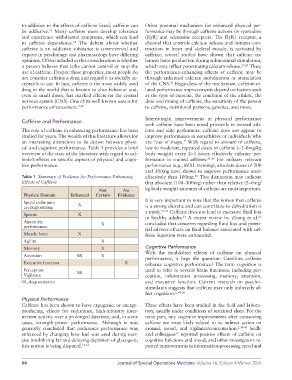
          Table 1  Summary of Evidence for Performance-Enhancing   effectively than 100mg.  This distinction may indicate
          Effects of Caffeine                                that absolute (100–300mg) rather than relative (2–6mg/
                                          Not       No       kg body weight) amounts of caffeine are most important.
           Physical Domain    Enhanced   Certain  Evidence
           Speed endurance       X                           It is very important to note that the notion that caffeine
           cycling/running                                   is a strong diuretic and can contribute to dehydration is
           Sprints               X                           a myth. 31-33  Caffeine does not lead to excessive fluid loss
                                                             in healthy adults.  A recent review by Zhang et al.
                                                                                                            33
                                                                             33
           Anaerobic                       X                 concluded that concerns regarding fluid loss and poten-
           performance                                       tial adverse effects on fluid balance associated with caf-
           Muscle force          X                           feine ingestion were unfounded.
           Agility                         X
           Memory                          X                 Cognitive Performance
           Attention             SR        X                 With the established effects of caffeine on physical
                                                             performance, it begs the question: Can/does caffeine
           Executive function                       X        enhance cognitive performance? The term cognition is
           Perception            SR                          used to refer to several brain functions, including per-
           Vigilance                                         ception, information processing, memory, attention,
          SR, sleep restriction.                             and executive function. Current research on psycho-
                                                             stimulants suggests that caffeine may only indirectly af-
                                                             fect cognition. 2,34–36
          Physical Performance
          Caffeine has been shown to have ergogenic, or energy-  These effects have been studied in the field and labora-
          producing, effects for endurance, high-intensity inter-  tory, usually under conditions of restricted sleep. For the
          mittent activity over a prolonged duration, and, in some   most part, any cognitive improvements after consuming
          cases, strength-power performance. Although it was   caffeine  are  most  likely  related  to  its  indirect  action  on
          generally concluded that endurance performance was   arousal, mood, and vigilance/concentration. 2,34-36  Seidle
          enhanced by changing how fuel was used during exer-  and colleagues  reported positive effects of caffeine on
                                                                         37
          cise (mobilizing fat and delaying depletion of glycogen),   cognitive functions and mood, and other investigators re-
          this notion is being disputed. 21,22               ported improvements in information-processing speed and


          66                                     Journal of Special Operations Medicine  Volume 16, Edition 4/Winter 2016

