


Page 51 - Journal of Special Operations Medicine - Winter 2016
P. 51
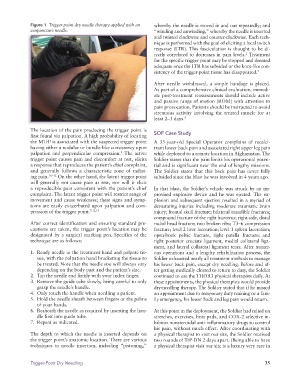
Figure 1  Trigger-point dry needle therapy applied with an   whereby the needle is moved in and out repeatedly; and
              acupuncture needle.                                “winding and unwinding,” whereby the needle is inserted
                                                                 and twisted clockwise and counter-clockwise. Each tech-
                                                                 nique is performed with the goal of  eliciting a local twitch
                                                                 response (LTR). This fasciculation is thought to be di-
                                                                 rectly correlated to decreases in pain levels.  Treatment
                                                                                                      2
                                                                 for the specific trigger point may be stopped and deemed
                                                                 adequate once the LTR has subsided or the knot-like con-
                                                                 sistency of the trigger-point tissue has disappeared. 9

                                                                 After needle withdrawal, a simple bandage is placed.
                                                                 As part of a comprehensive clinical evaluation, immedi-
                                                                 ate post-treatment reassessments should include active
                                                                 and passive range of motion (ROM) with attention to
                                                                 pain provocation. Patients should be instructed to avoid
                                                                 strenuous activity involving the treated muscle for at
                                                                 least 2–3 days. 9

              The location of the pain producing the trigger point is
              first found via palpation. A high probability of locating   SOF Case Study
              the MTrP is associated with the suspected trigger point   A 35-year-old Special Operator complains of recalci-
              having either a nodular or bundle-like consistency upon   trant lower back pain and associated right upper leg pain
              palpation and perpendicular compression.  The active   while deployed to a remote location in Afghanistan. The
                                                   9
              trigger point causes pain and discomfort at rest, elicits   Soldier states that the pain limits his operational poten-
              a response that reproduces the patient’s chief complaint,   tial and is significant near the end of lengthy missions.
              and generally follows a characteristic zone of radiat-  The Soldier states that this back pain has never fully
              ing pain. 10–12  On the other hand, the latent trigger point   subsided since the blast he was involved in 4 years ago.
              will generally not cause pain at rest,  nor will it elicit
              a reproducible pain consistent with the patient’s chief   In that blast, the Soldier’s vehicle was struck by an im-
              complaint. The latent trigger point will restrict range of   provised explosive device and he was ejected. The ex-
              movement and cause weakness; these signs and symp-  plosion and subsequent ejection resulted in a myriad of
              toms are easily exacerbated upon palpation and com-  devastating injuries including moderate traumatic brain
              pression of the trigger point. 7,12,13             injury; frontal skull fracture; bilateral mandible fractures;
                                                                 compound fracture of the right humerus; right-side, distal
              After correct identification and ensuring standard pre-  radial head fracture; two broken ribs; T3–6 compression
              cautions are taken, the trigger point’s location may be   fracture; level 2 liver laceration; level 1 spleen laceration;
              designated by a surgical marking pen. Specifics of the   open-book pelvic fracture, right patella fracture; and
              technique are as follows:                          right  posterior cruciate ligament, medial  collateral liga-
                                                                 ment, and lateral collateral ligament tears. After numer-
              1.  Ready needle in the treatment hand and palpate tis-  ous operations and a lengthy rehabilitation process, the
                sue, with the palpation hand bracketing the tissue to   Soldier exhausted nearly all treatment methods to manage
                be treated. Note that the needle size will always vary   his lower back pain, except dry needling. Before and af-
                depending on the body part and the patient’s size.  ter getting medically cleared to return to duty, the Soldier
              2.  Tap the needle end firmly with your index finger.  continued to use the THOR3 physical therapists daily. At
              3.  Remove the guide tube slowly, being careful to only   these appointments, the physical therapists would provide
                grasp the needle’s handle.                       dry-needling therapy. The Soldier stated that if he missed
              4.  Only touch the handle when needling a patient.  an appointment due to temporary duty training or a fam-
              5.  Hold the needle sheath between fingers or the palms   ily emergency, his lower back and leg pain would return.
                of your hands.
              6.  Resheath the needle as required by inserting the han-  At this point in the deployment, the Soldier had relied on
                dle first into guide tube.                       stretches, exercises, heat pads, and COX-2 selective in-
              7.  Repeat as indicated.                           hibitor nonsteroidal anti-inflammatory drugs to control
                                                                 his pain, without much effect. After coordinating with
              The depth to which the needle is inserted depends on   a physical therapist to visit our site, the Soldier received
              the trigger point’s anatomic location. There are various   two rounds of TrP-DN 2 days apart. (Being able to have
              techniques to needle insertion, including “pistoning,”   a physical therapist visit our site is a luxury very rare in


              Trigger-Point Dry Needling                                                                      35

