


Page 139 - Journal of Special Operations Medicine - Winter 2016
P. 139
CLSs have additional knowledge and training. After be-
                                                                 ing designated to that function, they receive training in
                                                                 the Armed Forces Hospitals in country. An extensive
                                                                 TCCC course (based on North Atlantic Treaty Organiza-
            Photograph by Bryan Ferreira and the 2nd Para Bn/KTM.  tice internship in a hospital is mandatory. After that, they
                                                                 tion [NATO] guidelines) is conducted and a small prac-

                                                                 are incorporated in their units, generally one per platoon
                                                                 section. There, the CLS receives specific training to incor-
                                                                 porate their recent knowledge into combat operations.

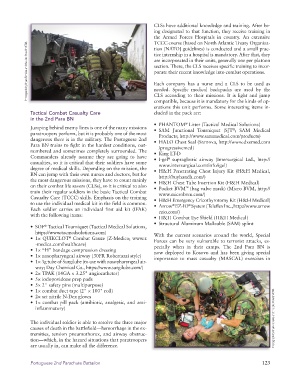
                                                                 Each company has a nurse and a CLS to be used as
                                                                 needed. Specific medical backpacks are  used by the
                                                                 CLS according to their missions. It is light and jump
                                                                   compatible, because it is mandatory for the kinds of op-
                                                                 erations this unit performs. Some interesting items in-
              Tactical Combat Casualty Care                      cluded in the pack are:
              in the 2nd Para BN
                                                                 •  PHANTOM  Litter (Tactical Medical Solutions)
                                                                             ®
              Jumping behind enemy lines is one of the many missions   •  SAM  Junctional  Tourniquet  (SJT ;  SAM Medical
                                                                                                 ®
              paratroopers perform, but it is probably one of the most   Products; http://www.sammedical.com/products)
              dangerous there is in the military. The Portuguese 2nd   •  HALO Chest Seal (Sarnova, http://www.dxemed.com
              Para BN trains to fight in the hardest conditions, out-  /progressivemed)
              numbered and sometimes completely surrounded. The   •  King LT-D
              Commanders already assume they are going to have   •  I-gel  supraglottic airway (Intersurgical Ltd., http://
                                                                      ®
              casualties, so it is critical that their soldiers have some   www.intersurgical.com/info/igel)
              degree of medical skills. Depending on the mission, the   •  H&H Penetrating Chest Injury Kit (H&H Medical,
              BN can jump with their own nurses and doctors, but for   http://buyhandh.com/)
              the most dangerous missions, they have to count mainly   •  H&H Chest Tube Insertion Kit (H&H Medical)
              on their combat life savers (CLSs), so it is critical to also   •  Pocket BVM  (bag valve mask) (Micro BVM, http://
                                                                              ™
              train their regular soldiers in the basic Tactical Combat   www.microbvm.com/)
              Casualty Care (TCCC) skills. Emphasis on the training   •  H&H Emergency Cricothyrotomy Kit (H&H Medical)
              to use the individual medical kit in the field is common.   •  Arrow  EZ-IO  System (Teleflex Inc., http://www.arrow
                                                                               ®
                                                                        ®
              Each soldier carries an individual first aid kit (IFAK)   ezio.com/)
              with the following items:
                                                                 •  H&H Combat Eye Shield (H&H Medical)
                                                                 •  Structural Aluminum Malleable (SAM) splint
              •  SOF  Tactical Tourniquet (Tactical Medical Solutions,
                   ®
                https://www.tacmedsolutions.com)
              •  1× QUIKCLOT  Combat Gauze (Z-Medica; www.z      With the current scenarios around the world, Special
                             ®
                                                                 Forces can be very vulnerable to terrorist attacks, es-
                -medica.com/healthcare)
              •  1× “H” bandage compression dressing             pecially when in their camps. The 2nd Para BN is
                                                                 now deployed to Kosovo and has been giving   special
              •  1× nasopharyngeal airway (30FR Robertazzi style)    importance to mass casualty (MASCAL) exercises in
              •  1× 3g tube of Surgilube (to use with nasopharyngeal air-
                way; Day Chemical Co., https://www.surgilube.com/)
              •  2× TPAK (14GA × 3.25" angiocatheter)
              •  5× iodopovidone prep pads
              •  5× 2" safety pins (multipurpose)
              •  1× combat duct tape (2" × 100" roll)
              •  2× set nitrile N-Dex gloves
              •  1× combat pill pack (antibiotic, analgesic, and anti-
                inflammatory)

              The individual soldier is able to resolve the three major                                           Photograph by Bryan Ferreira and the 2nd Para Bn/KTM.
              causes of death in the battlefield—hemorrhage in the ex-
              tremities, tension pneumothorax, and airway obstruc-
              tion—which, in the hazard situations that paratroopers
              are usually in, can make all the difference.


              Portuguese 2nd Parachute Battalion                                                             123

