


Page 5 - Journal of Special Operations Medicine - Summer 2016
P. 5
lessons learned over the last 14 years of war that in-                 n   n   n
              clude: (1) tourniquet use reliably stops bleeding from
              limb wounds and prevents mortality in prehospital   In addition, JSOM Associate Editors LTC David R.
              settings; and (2) brief tourniquet use appears to be   King, MD, FACS, and Piper L. Wall, DVM, PhD, and
              safe. These 2 lessons have become so evident that ci-  their colleagues have provided “Tourniquet Effective-
              vilian emergency medical systems have begun using   ness When Placed Over the Joint Service Lightweight
              them, albeit unevenly. Collection and interpretation   Integrated Suit Technology” and “Pressures Under
              of data of casualties with tourniquet use have showed   3.8cm, 5.1cm, and Side-by-Side 3.8cm-Wide Tourni-
              that such intervention has lifesaving benefit through 2   quets,” respectively.
              mechanisms: control of both ongoing hemorrhage and
              shock severity. The next generation of interventions in   This issue also features up-to-date information on field
              bleeding control involves developing the skill sets, ed-  sterilization,  animal-versus-synthetic  model  testing,
              ucation, and standards of tourniquet users which may   cooling technology, underwater inner ear barotrauma,
              improve hemorrhage control in wars to come.        and the National TEMS Competency Domains. Case re-
                                                                 ports cover herpes zoster on the Sinai Peninsula, prehos-
                                  n   n   n                      pital walking blood bank, and an anthrax presentation.

              We are fortunate to have three contributions in this is-  Our Ongoing Series experts present a variety of use-
              sue from Dr Kragh: “Preliminary Measures of Instructor   ful information on nausea, pain as  a barrier to  per-
              Learning in Teaching Junctional Tourniquet Users,” by   formance, Japanese encephalitis, program-induced
              John F. Kragh Jr, MD; James K. Aden 3rd, PhD; Stacy   cumulative overload, tattoos, personal hydration sys-
              A. Shackelford, MD; Michael A. Dubick, PhD; “Prelimi-  tem water reservoirs, and Niger’s CASEVAC Success.
              nary Comparison of Pneumatic Models of Tourniquet
              for Prehospital Control of Limb Bleeding in a Manikin,”   Fascinating  reviews  of  Modern  Irregular  Warfare  in
              by Ruby Gibson; James K. Aden 3rd, PhD; Michael A.   Defense Policy and as a Military Phenomenon by
              Dubick, PhD; John F. Kragh Jr, MD; and “SWAT Is a   Friedrich August Freiherr and Team of Teams: New
              Lifestyle; It’s a Way of Life: Ray Casillas on a Career in   Rules of Engagement for a Complex World by Gen-
              Operational Medicine,” interviewed by John F. Kragh   eral (Ret) Stanley McChrystal et al. round out this is-
              Jr, MD.                                            sue. We hope you enjoy it all!


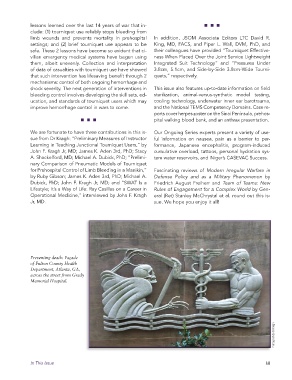
              Preventing death: Façade
              of Fulton County Health
              Department, Atlanta, GA,
              across the street from Grady
              Memorial Hospital.


                                                                                                                  Photograph by Dr Kragh


              In This Issue                                                                                    iii

