


Page 4 - Journal of Special Operations Medicine - Spring 2016
P. 4
by Allison Esposito, Managing Editor


          TIMELINESS                                         In his Infectious Diseases series, Burnett has provided
                                                             a summation of current knowledge regarding the Zika
          Timeliness in healthcare is the system’s capacity to   virus. Although originally written a few months ago, he
          provide care quickly after a need is recognized. Lack   has updated the information to give readers a clear pic-
          of timeliness can result in emotional distress, physi-  ture of what is known and what needs to be determined
          cal harm, and higher treatment costs. Inherent in the   about this growing international health threat.
          timely provision of care is the ability to provide the
          most accurate, up-to-date care available. The JSOM
          is committed to providing our readers with the best   VIEWPOINTS
          medical information from the leaders in their fields.
                                                                 Loyalty to petrified opinion never yet broke a
                                                                 chain or freed a human soul.
          Finalized in January 2016, the TCCC Guidelines                                     —Mark Twain
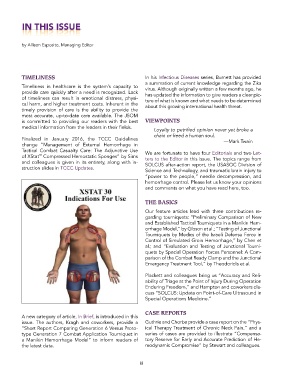
          change  “Management  of  External  Hemorrhage  in
          Tactical Combat Casualty Care: The Adjunctive Use   We are fortunate to have four Editorials and two Let-
          of XStat  Compressed Hemostatic Sponges” by Sims   ters to the Editor in this issue. The topics range from
                 ™
          and colleagues is given in its entirety, along with in-  SOLCUS after-action report, the USASOC Division of
          struction slides in TCCC Updates.
                                                             Science and Technology, and traumatic brain injury to
                                                             “power to the people,” needle decompression, and
                                                             hemorrhage control. Please let us know your opinions
                                                             and comments on what you have read here, too.

                                                             THE BASICS

                                                             Our feature articles lead with three contributions re-
                                                             garding tourniquets: “Preliminary Comparison of New
                                                             and Established Tactical Tourniquets in a Manikin Hem-
                                                             orrhage Model,” by Gibson et al.; “Testing of Junctional
                                                             Tourniquets by Medics of the Israeli Defense Force in
                                                             Control of Simulated Groin Hemorrhage,” by Chen et
                                                             al.; and “Evaluation and Testing of Junctional Tourni-
                                                             quets by Special Operation Forces Personnel: A Com-
                                                             parison of the Combat Ready Clamp and the Junctional
                                                             Emergency Treatment Tool,” by Theodoridis et al.

                                                             Plackett and colleagues bring us “Accuracy and Reli-
                                                             ability of Triage at the Point of Injury During Operation
                                                             Enduring Freedom,” and Hampton and coworkers dis-
                                                             cuss “SOLCUS: Update on Point-of-Care Ultrasound in
                                                             Special Operations Medicine.”


                                                             CASE REPORTS
          A new category of article, In Brief, is introduced in this
          issue. The authors, Kragh and coworkers, provide a   Guthrie and Chorba provide a case report on the “Phys-
          “Short Report Comparing Generation 6 Versus Proto-  ical Therapy Treatment of Chronic Neck Pain,” and a
          type Generation 7 Combat Application Tourniquet in   series of cases are provided to illustrate “Compensa-
          a Manikin Hemorrhage Model” to inform readers of   tory Reserve for Early and Accurate Prediction of He-
          the latest data.                                   modynamic Compromise” by Stewart and colleagues.


                                                           ii

