


Page 148 - Journal of Special Operations Medicine - Spring 2016
P. 148
Dr Frank Butler


                                                     ™
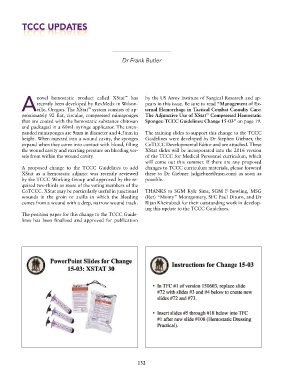
                novel hemostatic product called XStat  has   by the US Army Institute of Surgical Research and ap-
                  recently been developed by RevMedx in Wilson-  pears in this issue. Be sure to read “Management of Ex-
                                     ™
          A ville, Oregon. The XStat  system consists of ap-  ternal Hemorrhage in Tactical Combat Casualty Care:
                                                                                      ™
          proximately 92 flat, circular, compressed minisponges   The Adjunctive Use of XStat  Compressed Hemostatic
          that are coated with the hemostatic substance chitosan   Sponges: TCCC Guidelines: Change 15-03” on page 19.
          and packaged in a 60mL syringe applicator. The unex-
          panded minisponges are 9mm in diameter and 4.5mm in   The training slides to support this change to the TCCC
          height. When injected into a wound cavity, the sponges   Guidelines were developed by Dr Stephen Giebner, the
          expand when they come into contact with blood, filling   CoTCCC Developmental Editor and are attached. These
          the wound cavity and exerting pressure on bleeding ves-  XStat slides will be incorporated into the 2016 version
          sels from within the wound cavity.                 of the TCCC for Medical Personnel curriculum, which
                                                             will come out this summer. If there are any proposed
          A proposed change to the TCCC Guidelines to add    changes to TCCC curriculum materials, please forward
          XStat  as  a  hemostatic  adjunct  was  recently  reviewed   these to Dr Giebner (sdgiebner@msn.com) as soon as
          by the TCCC Working Group and approved by the re-  possible.
          quired two-thirds or more of the voting members of the
          CoTCCC. XStat may be particularly useful in junctional   THANKS to SGM Kyle Sims, SGM F Bowling, MSG
          wounds in the groin or axilla in which the bleeding   (Ret) “Monty” Montgomery, SFC Paul Dituro, and Dr
          comes from a wound with a deep, narrow wound track.  Bijan Kheirabadi for their outstanding work in develop-
                                                             ing this update to the TCCC Guidelines.
          The position paper for this change to the TCCC Guide-
          lines has been  finalized and approved for  publication


                                                          132

