


Page 4 - Journal of Special Operations Medicine - Winter 2014
P. 4
rs Givens and Lynch began their Operational Medicine   and enhance the intent of a quality medical journal,”  this
                                                                                                         2
          Din the Austere Environment Ongoing Series in the Fall   issue presents three. Drs Ellis and Brown present the case
          issue by providing “An Introduction to Medical Operations   of a Special Operations Soldier who developed anaphylaxis
          on the African Continent.” Authors Lynch, Verlo, Givens, and   as a consequence of a bee sting, resulting in compromise
          Munoz continue with a timely discussion of “Bites, Stings,   of the operation. Authors Kirkpatrick and McKee describe
                                                                                         ™
          and Rigors: Clinical Considerations in African Operations.”   the successful use of the iTClamp  50, a new hemorrhage
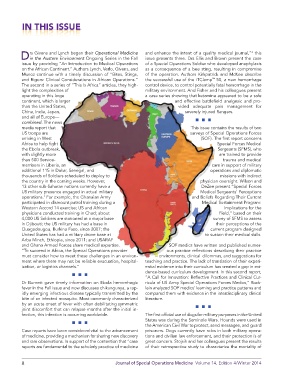
          The second in a series of “This Is Africa” articles, they high-  control device, to control potentially fatal hemorrhage in the
          light the complexities of                          military environment. And Fisher and his colleagues present
          operating in this large                            a case series showing that ketamine appeared to be a safe
          continent, which is larger                                     and effective battlefield analgesic and pro-
          than the United States,                                         vided adequate pain management for
          China, India, Japan,                                                 severely injured Rangers.
          and all of Europe—
          combined. The news                                                      n   n   n
          media report that                                                     This issue contains the results of two
          US troops are                                                        surveys of Special Operations Forces
          arriving in West                                                          (SOF). The first report concerns
          Africa to help fight                                                             Special Forces Medical
          the Ebola outbreak,                                                              Sergeants (SFMS), who
          with slightly more                                                                are trained to provide
          than 500 Service-                                                                    trauma and medical
          members in Liberia, an                                                         care in support of military
          additional 115 in Dakar, Senegal, and                                         operations and diplomatic
          thousands of Soldiers scheduled to deploy to                                      missions with indirect
          the country in the coming weeks. However,                                 physician oversight. Wilson and
          13 other sub-Saharan nations currently have a                             DeZee present “Special Forces
          US military presence engaged in actual military                            Medical Sergeants’ Perceptions
                   1
          operations.  For example, the Ghanaian Army                           and Beliefs Regarding Their Current
          participated in dismount patrol training during a                         Medical Sustainment Program:
          Western Accord 14 exercise; US and African                                          Implications for the
          physicians conducted training in Chad; about                                      Field,” based on their
          4,000 US Soldiers are stationed at a major base                                survey of SFMS to assess
          in Djibouti; the US military has had a base in                                   their perceptions of the
          Ouagadougou, Burkina Faso, since 2007; the                                    current program designed
          United States has had a military drone base at                              to sustain their medical skills.
          Arba Minch, Ethiopia, since 2011; and USARAF
          and Ghana Armed Forces share medical expertise.                  SOF medics have written and published numer-
          “To succeed in Africa, the Special Operations provider           ous practice reflections describing their practice
          must consider how to meet these challenges in an environ-     environments, clinical  dilemmas, and suggestions for
          ment where there may not be reliable evacuation, hospital-  teaching and practice. The lack of translation of their experi-
          ization, or logistics channels.”                   ential evidence into their curriculum has created a gap in evi-
                                                             dence-based curriculum development. In this second report,
                               n   n   n
                                                             “A Call for Innovation: Reflective Practices and Clinical Cur-
          Dr Burnett gave timely information on Ebola hemorrhagic   ricula of US Army Special Operations Forces Medics,” Rock-
          fever in the Fall issue and now discusses chikungunya, a rap-  lein analyzed SOF medics’ learning and practice patterns and
          idly emerging infectious disease typically transmitted by the   compared them with evidence in the interdisciplinary clinical
          bite of an infected mosquito. Most commonly characterized   literature.
          by an acute onset of fever with often debilitating symmetric
          joint discomfort that can relapse months after the initial in-          n   n   n
          fection, this infection is occurring worldwide.    The first official use of dogs for military purposes in the United
                                                             States was during the Seminole Wars. Hounds were used in
                               n   n   n
                                                             the American Civil War to protect, send messages, and guard
          Case reports have been considered vital to the advancement   prisoners. Dogs currently have roles in both military opera-
          of medicine, providing a mechanism for sharing new discovery   tions and civilian law enforcement, and their protection is of
          and rare observations. In support of the contention that “case   great concern. Stojsih and her colleagues present the results
          reports are fundamental to the scholarly practice of medicine   of their retrospective study to characterize the mortality of


          ii                                     Journal of Special Operations Medicine  Volume 14, Edition 4/Winter 2014

