


Page 24 - Journal of Special Operations Medicine - Winter 2014
P. 24
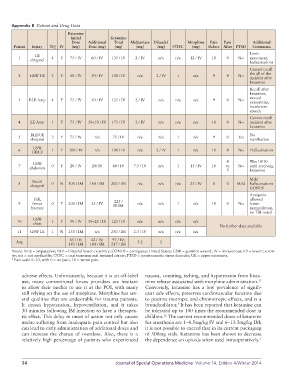
Appendix B  Patient and Drug Data
                             Ketamine
                              Initial          Ketamine
                               Dose   Additional   Total   Midazolam  Dilaudid   Morphine   Pain   Pain   Additional
       Patient  Injury  TQ  IV  (mg)  Dose (mg)  (mg)    (mg)     (mg)  OTFC    (mg)   Before  After  PTSD  Comments
                                                                                                        Limb
               LE
         1            4   Y   75 / IV  60 / IV  135 / IV  2 / IV  n/a    n/a    12 / IV  10    0   No   movement,
              shrapnel
                                                                                                        hallucinations
                                                                                                        Cannot recall
                                                                                                        the all of the
         2   GSW UE   2   Y   50 / IV  50 / IV  100 / IV  n/a     2 / IV  1      n/a     9     4   No   incident after
                                                                                                        ketamine
                                                                                                        Recall after
                                                                                                        ketamine,
                                                                                                        moved
         3   BLE Amp  4   Y   75 / IV  50 / IV  125 / IV  2 / IV  n/a    n/a     n/a     9     0   No
                                                                                                        extremities,
                                                                                                        incoherent
                                                                                                        speech
                                                                                                        Cannot recall
         4    LE Amp  1   Y   75 / IV  50+50 / IV  175 / IV  2 / IV  n/a  n/a    n/a    10     0   No   incident after
                                                                                                        ketamine

         5    BLE/UE   3  Y   75 / IV   n/a     75 / IV   n/a     n/a     1      n/a     9     0   Yes  No
              shrapnel                                                                                  recollection
               GSW
         6            1   Y   100 / IV  n/a    100 / IV   n/a     2 / IV  1      n/a    10     4   No   Hallucination
              UE/LE
                                                                                               4        Was 10/10
               GSW
         7            0   Y   20 / IV  20/ IV   40 / IV  7.5 / IV  n/a    1     15 / IV  10   to    No  until receiving
             abdomen
                                                                                               5        ketamine
                                                                                                        Mild
              Facial
         8            0   N  100 / IM  100 / IM  200 / IM  n/a    n/a    n/a    23 / IV  8     0   Mild  hallucinations
              shrapnel
                                                                                                        CONUS
                                                                                                        Analgesia
               Fall,                                                                                    allowed
         9    femur   0   Y  200 / IM  25 / IV  225 /     n/a     n/a     1      n/a    10     0   No   femur
              fracture                          IV-IM                                                   manipulation,
                                                                                                        no TBI noted
               GSW
        10            1   Y   50 / IV  50+25 / IV  125 / IV  n/a  n/a    n/a     n/a
               chest
                                                                                            No further data available
        11   GSW LE   1   N  250 / IM   n/a    250 / IM  2.5 / IV  n/a   n/a     n/a
                              65 / IV;   42 / IV;   97 / IV;
        Avg                                               3.2      2
                             183 / IM  100 / IM  217 / IM
      Notes: Amp = amputation; BLE = bilateral lower extremity; CONUS = contiguous United States; GSW = gunshot wound; IV = intravenous; LE = lower extrem-
      ity; n/a = not applicable; OTFC = oral transmucosal fentanyl citrate; PTSD = posttraumatic stress disorder; UE = upper extremity.
      *Pain scale 0–10, with 0 = no pain, 10 = worst pain.


          adverse effects. Unfortunately, because it is an off-label   nausea, vomiting, itching, and hypotension from hista-
                                                                                                            11
          use, many conventional forces providers are hesitant   mine release associated with morphine administration.
          to allow their medics to use it at the POI, with many   Conversely, ketamine has  a low prevalence  of  signifi-
          still relying on the use of morphine. Morphine has sev-  cant side effects, preserves cardiovascular function due
          eral qualities that are undesirable for trauma patients.   to positive inotropic and chronotropic effects, and is a
          It causes hypotension, hypoventilation, and it takes   bronchodilator.  It has been reported that ketamine can
                                                                          5
          30 minutes following IM injection to have a therapeu-  be tolerated up to 100 times the recommended dose in
          tic effect. This delay in onset of action not only causes   children.  The current recommended doses of ketamine
                                                                     12
          undue suffering from inadequate pain control but also   for anesthesia are 1–4.5mg/kg IV and 6–13.5mg/kg IM;
          can lead to early administration of additional doses and   it is not possible to exceed that in its current packaging
          can increase the chance of overdose. Also, there is a   of 500mg vials. Ketamine has been shown to decrease
          relatively high percentage of patients who experienced   the dependence on opioids when used intraoperatively. 5


          14                                     Journal of Special Operations Medicine  Volume 14, Edition 4/Winter 2014

