


Page 97 - Journal of Special Operations Medicine - Summer 2014
P. 97
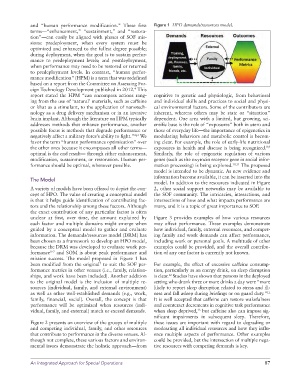
and “human performance modification.” These first   Figure 1  HPO demands/resources model.
              terms—“enhancement,” “sustainment,” and “restora-
              tion”—can easily be aligned with phases of SOF mis-
              sions: predeployment, when every system must be
              optimized and enhanced to the fullest degree possible;
              during deployment, when the goal is to sustain perfor-
              mance to predeployment levels; and postdeployment,
              when performance may need to be restored or returned
              to  predeployment  levels.  In  contrast,  “human  perfor-
              mance modification” (HPM) is a term that was redefined
              based on a report from the Committee on Assessing For-
              eign Technology Development published in 2012.  This
                                                         4
              report  stated  the  HPM  “can  encompass  actions  rang-  cognitive  to  genetic  and  physiologic,  from  behavioral
              ing from the use of ‘natural’ materials, such as caffeine   and individual skills and practices to social and physi-
              or khat as a stimulant, to the application of nanotech-  cal environmental factors. Some of the contributors are
              nology as a drug delivery mechanism or in an invasive   inherent, whereas others may be state or “situation”
              brain implant. Although the literature on HPM typically   dependent. One area with a limited, but growing, sci-
              addresses methods that enhance performance, another   entific base is the role of “exposures” both in utero and
              possible focus is methods that degrade performance or   those of everyday life—the importance of epigenetics in
              negatively affect a military force’s ability to fight.”  We   modulating behaviors and metabolic control is becom-
                                                        4p1
              favor the term “human performance optimization” over   ing clear. For example, the role of early-life nutritional
              the other ones because it encompasses all other terms—  exposures in health and disease is being recognized.
                                                                                                               8,9
              optimal is the end result— through either enhancement,   Similarly, the role of epigenetic regulation of various
              modification, sustainment, or restoration. Human per-  genes (such as the oxytocin receptor gene in social infor-
              formance should be optimal, whenever possible.     mation processing) is being explored. 10,11  The proposed
                                                                 model is intended to be dynamic. As new evidence and
                                                                 information become available, it can be inserted into the
              The Model
                                                                 model. In addition to the resources indicated in Figure
              A variety of models have been offered to depict the con-  2, other social support networks may be available to
              cept of HPO. The value of creating a conceptual model   the SOF community. The intricacies, interactions, and
              is that it helps guide identification of contributing fac-  intersections of how and what impacts performance are
              tors and the relationship among these factors. Although   many, and it is a topic of great importance to SOF.
              the exact contribution of any particular factor is often
              unclear at first, over time, the amount explained by   Figure 3 provides examples of how various resources
              each factor and multiple domains might emerge when   may affect performance. These examples demonstrate
              guided by a conceptual model to gather and evaluate   how individual, family, external resources, and compet-
              information. The demands/resources model (DRM) has   ing family and work demands can affect performance,
              been chosen as a framework to develop an HPO model,   including work or personal goals. A multitude of other
              because the DRM was developed to evaluate work per-  examples could be provided, and the overall contribu-
              formance  and SOM is about peak performance and    tion of any one factor is currently not known.
                      5–7
              mission success. The model proposed in Figure 1 has
              been modified from the original  to suit the SOF per-  For example, the effect of excessive caffeine consump-
                                          7
              formance metrics in other venues (i.e., family, relation-  tion, particularly as an energy drink, on sleep disruption
              ships, and work have been included). Another addition   is clear.  Studies have shown that persons in the deployed
                                                                       12
              to the original model is the inclusion of multiple re-  setting who drank three or more drinks a day were “more
              sources (individual, family, and external environment)   likely to report sleep disruption related to stress and ill-
              as well as other well-established demands (e.g., work,   ness and fall asleep during briefings or on guard duty.”
                                                                                                               12
              family, financial, social). Overall, the concept is that   It is well accepted that caffeine can restore wakefulness
              performance will be optimized when resources (indi-  and counteract decrements in cognitive task performance
              vidual, family, and external) match or exceed demands.  when sleep deprived,  but caffeine also can impose sig-
                                                                                   13
                                                                 nificant impairments in subsequent sleep. Therefore,
              Figure 2 presents an overview of the groups of multiple   these issues are important with regard to degrading or
              and competing individual, family, and other resources   moderating all individual resources and how they influ-
              that contribute to performance in the diverse venues. Al-  ence multiple aspects of performance. Other examples
              though not complete, these various factors and environ-  could be provided, but the intersection of  multiple nega-
              mental issues demonstrate the holistic approach—from   tive resources with competing demands is key.


              An Integrated Approach for Special Operations                                                   87

