


Page 120 - Journal of Special Operations Medicine - Spring 2014
P. 120
In 2005, Morgan completed his emergency medicine   the ultrasound training,” said Morgan. “It is now in the
          residency at Fort Lewis, WA, now called Joint Base   curriculum at the school house for all Special Forces
          Lewis-McChord, and then to his next assignment at   medics.”
          Fort Bragg, NC. He was a staff emergency physician at
          the Womak Army Medical Center, and began duties as   During his seven years in Special Forces, Morgan de-
          an emergency physician and flight surgeon for the Army   ployed three times to Operation Enduring Freedom,
          Special Operations community.                      Afghanistan and Operation Iraqi Freedom, developing
                                                             skills he believed made him stand out among the other
          Always looking for more opportunities and challenges,   candidates during the astronaut selection process.
          Morgan,  already  jump  qualified  from  his  West  Point
          days, Morgan went on to graduate from Ranger school.   “The opportunities and training in the Army and work-
          He completed the combat diver’s course and earned his   ing in the Special Operations community made me learn
          military free fall qualification. Along the way he re-  to think outside the box, and become somewhat stress
          ceived flight surgeon accreditation.               inoculated,” said Morgan. “Those skills and my combat
                                                             experience was something, I think, made a difference in
          In the course of his career he was assigned to the 3rd   my selection.”
          Special Forces Group (Airborne), Fort Bragg. “I believe
          the most rewarding job of my career was the three years   Morgan and his family moved to Houston in July, and
          I spent as battalion surgeon in 1st Battalion, 3rd Special   started the astronaut training program to develop his
          Forces Group, the Desert Eagles,” said Morgan. “It de-  skills for future space flights.
          veloped my passion for teaching Special Forces medics
          the skills they would use in the field. I learned as much   “I was not hired as a medical doctor for the astronaut
          from them as I hope they learned from me.”         mission. Instead, I will be a mission specialist who hap-
                                                             pens to have medical skills,” Morgan said.
          Morgan’s work in field medicine while deployed, led
          to another challenge. His battalion medical team be-  Morgan said the next two years will likely include flight
          lieved the use of ultrasound technology in the field was   training,  robotics  instruction  and Russian-language
          feasible.                                          courses. It will be two years of candidate training before
                                                             receiving full astronaut status.
          “Morgan had the determination and vision to handle
          the initial resistance to the “good idea” of teaching SF   “I would have been happy to finish my career in the
          medics how to use ultrasound. He was flexible enough   Army,” Morgan said. “But, this is an even greater call-
          to receive the feedback from the medics and adjust the   ing. It’s the only thing in the world that I would leave my
          application from the standard of care in the fixed fa-  old career behind for.”
          cility ER to the austere environment of the SF battle-
          field,” said MAJ William N. Vasios III, command and   Morgan is quick to note
          regimental physician assistant, U.S. Army Special Forces   in  conversation,  that
          Command (Airborne). “He always encouraged the med-  he is just a regular guy
          ics to seek higher professional training whether learning   who is still on and will
          to become a physician’s assistant or attending medical   remain on active duty,
          school.”                                           adding that he is proud
                                                             to be representing the
          “Drew is a top performer of unlimited potential and in-  Army and the Special
          tellect, and although losing his talent in USASOC, it’s a   Operations community.                    Photo courtesy of U.S. Army
          gain for America’s space program,” said COL Peter J.
          Benson, USASOC surgeon. “He’s a top flight emergency   His friends agree he is a
          medicine physician and has a special expertise at emer-  regular guy, but a regu-
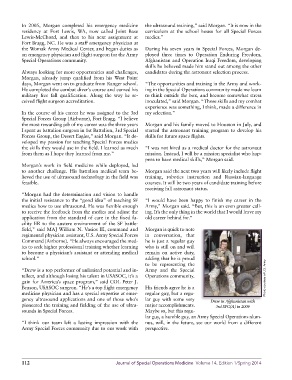
          gency ultrasound applications and one of those who’s   lar guy with some very   Drew in Afghanistan with
          pioneered the training and fielding of the use of ultra-  major accomplishments.   3rd SFG(A) in 2009
          sounds in Special Forces.                          Maybe so, but this regu-
                                                             lar guy, a humble guy, an Army Special Operations alum-
          “I think our team left a lasting impression with the   nus, will, in the future, see our world from a different
          Army Special Forces community due to our work with   perspective.


          112                                    Journal of Special Operations Medicine  Volume 14, Edition 1/Spring 2014

