


Page 234 - ATP-P 11th Ed
P. 234
EPISTAXIS PROTOCOL


           SPECIAL CONSIDERATIONS
           1.  Common at high altitude and in desert environments due to mucosal drying.
           2.  May be anterior or posterior
           3.  Posterior epistaxis may be difficult to stop and may cause respiratory distress
             due to blood flowing into the airway. This type of epistaxis is uncommon in
   SECTION 2    Signs and Symptoms
             young healthy adults. It is more commonly seen in older, hypertensive patients.


        1.  Nosebleed
        2.  Often previous history of nosebleeds
        3.  Usually anterior
        Management
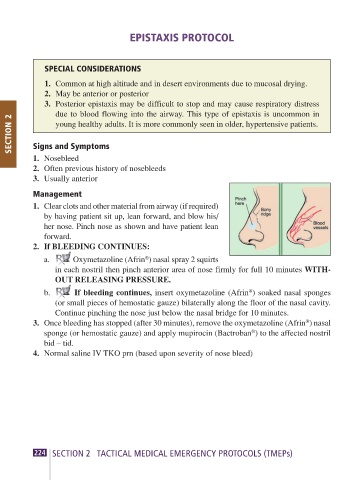
        1.  Clear clots and other material from airway (if required)
           by having patient sit up, lean forward, and blow his/
           her nose. Pinch nose as shown and have patient lean
           forward.
        2.   If BLEEDING CONTINUES:
           a.     Oxymetazoline (Afrin ) nasal spray 2 squirts
                                 ®
             in each nostril then pinch anterior area of nose firmly for full 10 minutes WITH-
             OUT RELEASING PRESSURE.
           b.     If bleeding continues, insert oxymetazoline (Afrin ) soaked nasal sponges
                                                       ®
             (or small pieces of hemostatic gauze) bilaterally along the floor of the nasal cavity.
             Continue pinching the nose just below the nasal bridge for 10 minutes.
                                                                    ®
        3.  Once bleeding has stopped (after 30 minutes), remove the oxymetazoline (Afrin ) nasal
                                                        ®
           sponge (or hemostatic gauze) and apply mupirocin (Bactroban ) to the affected nostril
           bid – tid.
        4.  Normal saline IV TKO prn (based upon severity of nose bleed)


          224  SECTION 2   TACTICAL MEDICAL EMERGENCY PROTOCOLS (TMEPs)                                                       ATP-P Handbook 11th Edition 225

