


Page 100 - 2021 Advanced Ranger First Responder Handbook
P. 100
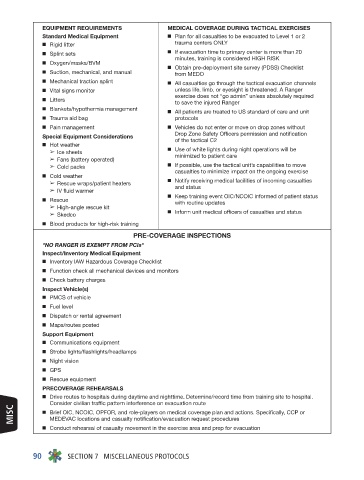
EQUIPMENT REQUIREMENTS     MEDICAL COVERAGE DURING TACTICAL EXERCISES
          Standard Medical Equipment  ■   Plan for all casualties to be evacuated to Level 1 or 2
          ■   Rigid litter             trauma centers ONLY
          ■   Splint sets            ■   If evacuation time to primary center is more than 20
                                       minutes, training is considered HIGH RISK
          ■   Oxygen/masks/BVM
                                     ■   Obtain pre-deployment site survey (PDSS) Checklist
          ■   Suction, mechanical, and manual  from MEDO
          ■   Mechanical traction splint  ■   All casualties go through the tactical evacuation channels
          ■   Vital signs monitor      unless life, limb, or eyesight is threatened. A Ranger
                                       exercise does not “go admin” unless absolutely required
          ■   Litters
                                       to save the injured Ranger
          ■   Blankets/hypothermia management
                                     ■   All patients are treated to US standard of care and unit
          ■   Trauma aid bag           protocols
          ■   Pain management        ■   Vehicles do not enter or move on drop zones without
          Special Equipment Considerations  Drop Zone Safety Officers permission and notification
                                       of the tactical C2
          ■   Hot weather
            ➢   Ice sheets           ■   Use of white lights during night operations will be
            ➢   Fans (battery operated)  minimized to patient care
            ➢   Cold packs           ■   If possible, use the tactical unit’s capabilities to move
                                       casualties to minimize impact on the ongoing exercise
          ■   Cold weather
            ➢   Rescue wraps/patient heaters  ■   Notify receiving medical facilities of incoming casualties
            ➢   IV fluid warmer        and status
                                     ■   Keep training event OIC/NCOIC informed of patient status
          ■   Rescue                   with routine updates
            ➢   High-angle rescue kit
            ➢   Skedco               ■   Inform unit medical officers of casualties and status
          ■   Blood products for high-risk training
                              PRE-COVERAGE INSPECTIONS
          *NO RANGER IS EXEMPT FROM PCIs*
          Inspect/Inventory Medical Equipment
          ■   Inventory IAW Hazardous Coverage Checklist
          ■   Function check all mechanical devices and monitors
          ■   Check battery charges
          Inspect Vehicle(s)
          ■   PMCS of vehicle
          ■   Fuel level
          ■   Dispatch or rental agreement
          ■   Maps/routes posted
          Support Equipment
          ■   Communications equipment
          ■   Strobe lights/flashlights/headlamps
          ■   Night vision
          ■   GPS
          ■   Rescue equipment
          PRECOVERAGE REHEARSALS
          ■   Drive routes to hospitals during daytime and nighttime. Determine/record time from training site to hospital.
            Consider civilian traffic pattern interference on evacuation route
    MISC  ■   Brief OIC, NCOIC, OPFOR, and role-players on medical coverage plan and actions. Specifically, CCP or
            MEDEVAC locations and casualty notification/evacuation request procedures
          ■   Conduct rehearsal of casualty movement in the exercise area and prep for evacuation

        90      SECTION 7   MISCELLANEOUS PROTOCOLS

