


Page 96 - 2025 Ranger Medic Handbook
P. 96
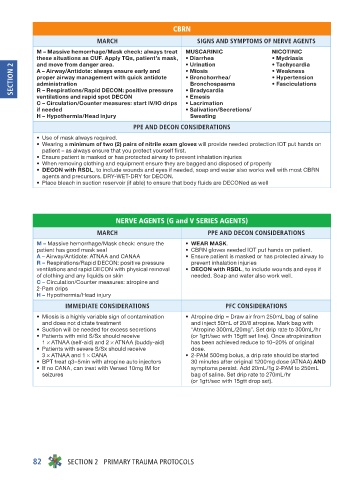
CBRN
                      MARCH                 SIGNS AND SYMPTOMS OF NERVE AGENTS
         M – Massive hemorrhage/Mask check: always treat   MUSCARINIC  NICOTINIC
         these situations as CUF. Apply TQs, patient’s mask,   • Diarrhea   • Mydriasis
                                         • Urination
                                                            • Tachycardia
         and move from danger area.
    SECTION 2  A – Airway/Antidote: always ensure early and   • Miosis   • Weakness
                                                            • Hypertension
         proper airway management with quick antidote
                                         • Bronchorrhea/
                                                            • Fasciculations
         administration
                                            Bronchospasms
         R – Respirations/Rapid DECON: positive pressure
                                         • Bradycardia
         ventilations and rapid spot DECON
         C – Circulation/Counter measures: start IV/IO drips   • Emesis
                                         • Lacrimation
         if needed                       • Salivation/Secretions/
         H – Hypothermia/Head injury        Sweating
                              PPE AND DECON CONSIDERATIONS
         •  Use of mask always required.
         •  Wearing a minimum of two (2) pairs of nitrile exam gloves will provide needed protection IOT put hands on
          patient – as always ensure that you protect yourself first.
         •  Ensure patient is masked or has protected airway to prevent inhalation injuries
         •  When removing clothing and equipment ensure they are bagged and disposed of properly
         •  DECON with RSDL, to include wounds and eyes if needed, soap and water also works well with most CBRN
          agents and precursors. DRY-WET-DRY for DECON.
         •  Place bleach in suction reservoir (if able) to ensure that body fluids are DECONed as well
                          NERVE AGENTS (G and V SERIES AGENTS)
                      MARCH                   PPE AND DECON CONSIDERATIONS
         M – Massive hemorrhage/Mask check: ensure the   •  WEAR MASK.
         patient has good mask seal      •  CBRN gloves needed IOT put hands on patient.
         A – Airway/Antidote: ATNAA and CANAA  •  Ensure patient is masked or has protected airway to
         R – Respirations/Rapid DECON: positive pressure   prevent inhalation injuries
         ventilations and rapid DECON with physical removal    •  DECON with RSDL, to include wounds and eyes if
         of clothing and any liquids on skin  needed. Soap and water also work well.
         C – Circulation/Counter measures: atropine and
         2-Pam drips
         H – Hypothermia/Head injury
               IMMEDIATE CONSIDERATIONS           PFC CONSIDERATIONS
         •  Miosis is a highly variable sign of contamination    •  Atropine drip = Draw air from 250mL bag of saline
          and does not dictate treatment   and inject 50mL of 20/8 atropine. Mark bag with
         •  Suction will be needed for excess secretions  “Atropine 300mL/20mg”. Set drip rate to 300mL/hr
         •  Patients with mild S/Sx should receive    (or 1gtt/sec with 15gtt set line). Once atropinization
          1 × ATNAA (self-aid) and 2 × ATNAA (buddy-aid)  has been achieved reduce to 10–20% of original
         •  Patients with severe S/Sx should receive    dose.
          3 × ATNAA and 1 × CANA         •  2-PAM 500mg bolus, a drip rate should be started
         •  BPT treat q3–5min with atropine auto injectors  30 minutes after original 1200mg dose (ATNAA) AND
         •  If no CANA, can treat with Versed 10mg IM for   symptoms persist. Add 20mL/1g 2-PAM to 250mL
          seizures                         bag of saline. Set drip rate to 270mL/hr
                                           (or 1gtt/sec with 15gtt drop set).


        82      SECTION 2   PRIMARY TRAUMA PROTOCOLS

