


Page 248 - 2025 Ranger Medic Handbook
P. 248
Rehearsals. Rehearsals familiarize unit members with the mission plan and visualize the expected action. Depending on
        the level and repetition of rehearsal, unit members can develop a thorough familiarity with the sequence of events that
        will be executed. A rehearsal should be conducted as a scripted event that lays out the operational plan in a sequence of
        overlapping events. Contingencies and complications can be injected to assess unit member reactions and to practice
        alternate plans.
        Full dress rehearsals provide the most detailed understanding of the operation and involve all unit members executing
        their expected tasks flowing through the expected timeline of the event. A full dress rehearsal is a military field exercise;
        a training event preparing for the real event at a similar location layout. A Reduced Force Rehearsal involves only key
        leadership of subordinates and operational units. Terrain model rehearsals, also known as ROC drills or sandbox drills, use
        miniature depictions of the operational area. Terrain model rehearsals are historically the most commonly used method for
        rehearsal of military operations. Map rehearsals can be used virtually anywhere using actual maps, imagery or sketches
        of operational areas.
        A communications rehearsal, also known as a COMMEX, is a combination of testing communications systems as well as
        unit members running through the sequence of events through radio calls. For the communications equipment tests, using
        the same equipment, same frequencies, and same distances specified in the operational plan will provide the unit with
        the best insight into whether their equipment will function properly. If possible, line-of-sight obstacles such as buildings
        or terrain should be interposed between radios to exactly replicate conditions at the target. Casualty response specific
        execution checklist calls must be integrated into the overall unit EXCHECK. Example calls may be CCP established,
        evacuation asset in place/on station, casualty HLZ (CEP or AXP) established, and most importantly the radio notification
        call for a casualty report. Contingency or deviation calls may be required for mass casualty situations, accidents/incidents
        involving aircraft or vehicles, and changes from primary to alternate aircraft/vehicles, key locations, evacuation assets, or
        receiving medical facilities.
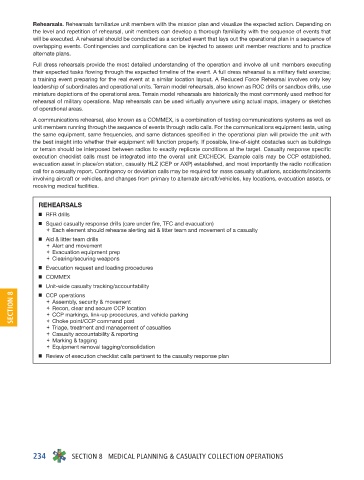
         REHEARSALS
         ■   RFR drills
         ■   Squad casualty response drills (care under fire, TFC and evacuation)
           É   Each element should rehearse alerting aid & litter team and movement of a casualty
         ■   Aid & litter team drills
           É   Alert and movement
           É   Evacuation equipment prep
           É   Clearing/securing weapons
         ■   Evacuation request and loading procedures
         ■   COMMEX
         ■ ■   Unit-wide casualty tracking/accountability
    SECTION 8  É   Assembly, security & movement
            CCP operations
              Recon, clear and secure CCP location
           É
              CCP markings, link-up procedures, and vehicle parking
           É
           É
              Triage, treatment and management of casualties
           É   Choke point/CCP command post
           É   Casualty accountability & reporting
           É   Marking & tagging
           É   Equipment removal tagging/consolidation
         ■   Review of execution checklist calls pertinent to the casualty response plan


        234      SECTION 8   MEDICAL PLANNING & CASUALTY COLLECTION OPERATIONS

